Cheap Draft-Proofing Fixes That Actually Work
Last checked: October 29, 2026. Reviewed and expanded on October 31, 2026.
Draft-proofing (draught-proofing in the UK) is one of the few home energy jobs where most of the work costs less than a takeaway and takes an afternoon. It won’t transform your bills on its own. The Energy Saving Trust estimates around £55 a year in Great Britain for draught-proofing windows, doors and floors, and £80 in Northern Ireland. But a room without draughts feels warmer at the same temperature, and that is where the bigger savings come from: the Trust estimates that turning your thermostat down from 22 °C to 21 °C saves about £120 a year in Great Britain.
Here is where to start, what to buy and what not to block.
First, find the draughts
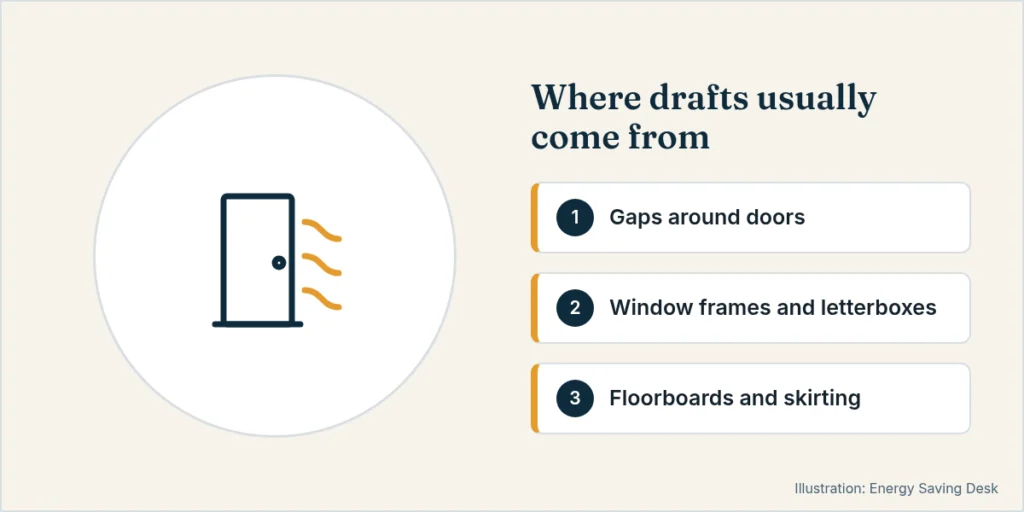
On a cold, windy day, walk around slowly with the back of your hand or a damp finger near:
- window frames and the meeting rails of sash windows
- external doors, especially the bottom edge
- letterboxes and keyholes
- loft hatches
- gaps between floorboards and under skirting boards
- where pipes and cables pass through outside walls
- an unused open fireplace
A lit incense stick also works well. Watch which way the smoke moves. Some smart thermal cameras and phone attachments make it obvious, but you don’t need one.
Fixes that cost very little
Doors
- Brush or hinged draught excluder on the bottom of external doors. Screw-fixed versions last much longer than stick-on ones.
- Foam or rubber seal strips around the frame. Measure the gap first. A strip that is too thick stops the door closing properly and gets crushed. One that’s too thin does nothing.
- Letterbox brush or flap, and a keyhole cover. Small parts that fix a surprisingly cold stream of air.
Windows
- Self-adhesive foam strips are the cheapest option and easy to fit, but don’t last as long.
- Brush or wiper strips (metal or plastic) cost more but last for years. They are the better choice for sash windows, where foam works poorly.
- Silicone sealant for gaps around frames that don’t open.
- Temporary film kits (shrink film over the frame) are an effective winter fix for single glazing if you rent.
Floors and skirting
- Flexible filler or a silicone-based sealant for gaps between floorboards and along skirting boards on suspended timber floors. Keep the air bricks outside clear, because the void under the floor needs ventilation.
Loft hatch
- Foam strip around the hatch, and a piece of insulation board fixed to its top. An uninsulated hatch is often a cold patch in an otherwise insulated ceiling.
Chimney
- Chimney balloon or draught excluder for a fireplace you don’t use. The Energy Saving Trust estimates about £45 a year in GB and £60 in Northern Ireland. Always remove it before lighting a fire, and leave a little ventilation as the product instructions describe.
What NOT to block
Draughts are uncontrolled air. Ventilation is controlled air, and your home needs it to keep damp and condensation down.
- Don’t seal trickle vents in window frames, wall vents or air bricks.
- Don’t block extractor fans or vents in kitchens and bathrooms.
- Rooms with a fuel-burning appliance (open-flue boiler, gas fire, wood burner) need their dedicated air supply. Don’t touch it, and if in doubt ask a Gas Safe (UK) or qualified (US) engineer.
- If your home is already fairly airtight, more draught-proofing can make air quality worse. The Energy Saving Trust makes this point too.
Worked example: what pays back first
All figures are the Energy Saving Trust’s estimates for Great Britain, quoted above:
- DIY draught-proofing of windows, doors and floors saves about £55 a year. If the materials cost less than that, it pays back in the first winter.
- Professional draught-proofing at about £250 pays back in about 4.5 years (£250 ÷ £55).
- A chimney balloon saves about £45 a year, so any balloon under £45 pays for itself within one winter.
- The comfort effect is the big one. If a draught-free room lets you turn the thermostat down from 22 °C to 21 °C, that’s worth about £120 a year, more than twice the draught-proofing saving itself.
Together that’s about £175 a year for a weekend of work. Compare that with topping up a loft from 120 mm to 270 mm: £600–£800 for £17–£35 a year (see our loft insulation guide). That’s why draughts come first.
To test a professional quote against your own energy use and prices, try our is it worth switching? calculator.
When draught-proofing isn’t the answer
- You already have condensation or mould. Sealing gaps reduces air changes. Sort out ventilation first, such as extractor fans and trickle vents, or you may make the damp worse.
- The home is already fairly airtight. The Energy Saving Trust warns that more sealing can make air quality worse.
- You rent. Stick to removable fixes: film kits, stick-on foam, letterbox brushes and chimney balloons. Ask before you screw anything to doors or frames.
- A listed or period building. Check with your council’s conservation officer before changing original windows or doors.
- You expect a big drop in your bills. The savings are real but modest. The main benefit is comfort, and the setting you can turn the thermostat down to.
DIY or professional?
DIY works for most doors, windows and hatches. The Energy Saving Trust estimates professional draught-proofing of windows and doors for a whole house at around £250. Consider a professional for old sash windows (specialist brush-seal systems), suspended floors over large areas, or if you’ve already done the basics and still have cold, damp rooms. That may point to a ventilation or insulation problem rather than draughts.
In the US
The same principles apply. The US Department of Energy recommends sealing air leaks before adding insulation, and many utilities offer free or subsidised home energy audits with a blower-door test, which pinpoints leaks far better than the hand test. Check your utility’s website before you buy materials.
Related guides
- Loft and attic insulation: cost and savings
- Heat pump running costs vs gas
- Smart thermostats for heat pumps
More guides in Insulation & Draught-Proofing.
Sources
- Energy Saving Trust, Draught proofing: https://energysavingtrust.org.uk/advice/draught-proofing/
- Energy Saving Trust, Quick tips to save energy: https://energysavingtrust.org.uk/hub/quick-tips-to-save-energy/
- Which?, How to draughtproof your home: https://www.which.co.uk/reviews/insulation/article/draught-proofing-aLi4N0F4P7VH
- U.S. DOE, Guide to air sealing: https://www.energy.gov/sites/prod/files/guide_to_air_sealing.pdf