Plug-In and Balcony Solar: What’s Allowed in the UK and US (2026)
Last checked: October 29, 2026. Reviewed and expanded on October 31, 2026. Rules are changing fast. Check the linked sources before buying.
Plug-in solar means a small panel kit with a micro-inverter that you plug into an ordinary socket. It has been normal in Germany for years. In 2026 it finally became legal in Great Britain, and a growing list of US states allow it. The rules are specific, though, and the kits sold online don’t always meet them.
United Kingdom
Since August 27, 2026, plug-in solar has been allowed in England, Scotland and Wales under statutory instrument SI 2026/848. It hasn’t been extended to Northern Ireland yet.
Key limits from the government’s interim product specification:
- Inverter output: no more than 800 VA (about 3.5 A).
- Panels: no more than 2,000 W of panels on the DC side.
- Plug: a standard BS 1363 (UK 3-pin) plug into a fixed wall socket. No extension leads or adapters.
- One device per household under the current G98 connection route, even though the product spec allows one per final circuit.
- Above roughly 960 W of panels, a professional assessment of your circuit is advised.
- Notify your distribution network operator (DNO) within 28 days of connecting.
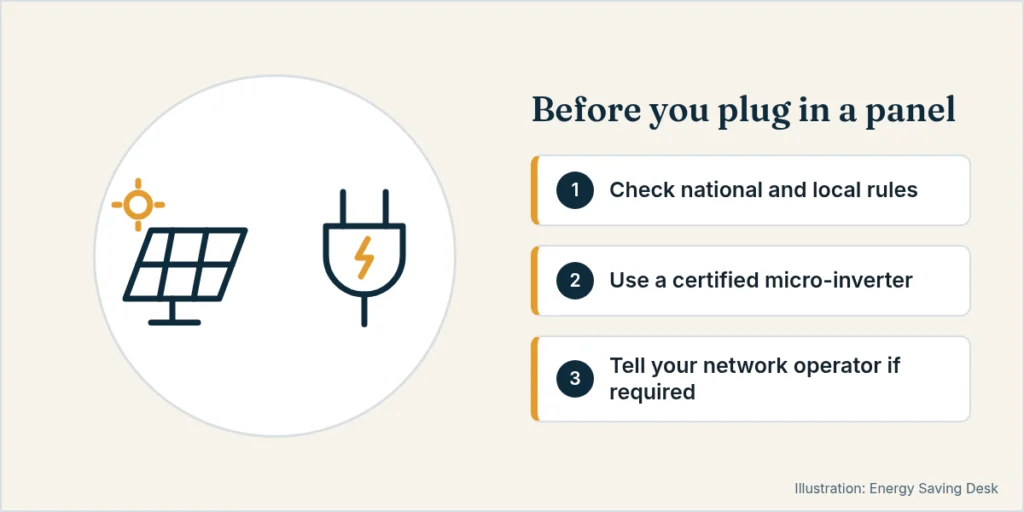
Buy kits that state compliance with the UK specification. A German “balkonkraftwerk” kit with a Schuko plug and adapter does not comply.
What it can save (rough estimate): a south-facing 800 W panel set in England might produce somewhere around 600–750 kWh a year, depending on orientation and shading. You’ll only save money on what you use as it’s generated, often half or less without a battery. At 26.32p/kWh (Ofgem’s October–December 2026 average), 350 kWh used at home is worth about £92 a year. Treat that as a ballpark, not a promise. For an estimate with your own yield, self-use share and price, the solar panel payback calculator works for a small plug-in kit too.
United States
There’s no federal rule. Plug-in (“balcony”) solar is regulated state by state.
- Utah led with H.B. 340, in force since May 7, 2025: portable systems up to 1,200 W, UL-listed, NEC-compliant and with anti-islanding protection. No utility interconnection agreement is needed, and the systems sit outside net metering.
- As of October 2026, Solar United Neighbors counts ten states with plug-in solar laws: Utah, Maine, Maryland, Vermont, Colorado and Connecticut already in effect, and California, New Hampshire, Virginia and New Jersey phasing in by about March 2027.
In other states, connecting any generator to your home’s wiring without utility approval can break interconnection rules, even if nobody checks. Renters should also check their lease.
Worked example: what a kit has to cost to make sense
Take the middle of the estimate above: 675 kWh a year from an 800 W kit in England. What you save depends almost entirely on how much of that you use yourself, at 26.32p/kWh:
- 40% self-use (270 kWh): about £71 a year
- 60% self-use (405 kWh): about £107 a year
- 80% self-use, with a battery or someone home all day (540 kWh): about £142 a year
So a £450 kit at 60% self-use pays back in a little over 4 years. A £900 kit with a battery needs the higher self-use to pay back in about 6 years (£900 ÷ £142). Exports usually earn nothing, so a bigger kit than you can use only adds to the payback time.
In the US the maths depends on your state. At the U.S. average of 18.16¢/kWh (EIA, August 2026), every 100 kWh you use yourself is worth about $18. In California, where the average residential rate was 29.75¢, it’s worth about $30. Low-rate states make plug-in solar a slow payback.
Who it’s not for (yet)
- North-facing or heavily shaded balconies. Output can fall far below the estimate above.
- Households out all day with a low baseload. Most of the output would be exported for nothing.
- Leaseholders and renters without written permission to fix panels to the building. Mounting on a facade or railing usually needs the freeholder’s or landlord’s OK.
- Northern Ireland, where it isn’t allowed yet, and US states without a plug-in law.
- Anyone who wants backup. These kits switch off in a power cut.
What to look for in a kit
- Certification for your market (UK spec compliance; UL 1741 or equivalent in the US).
- An inverter that shuts off when the grid goes down (anti-islanding). This is required for safety.
- Secure mounting rated for wind. A panel falling off a balcony is the real risk.
- Monitoring through an app or a plug-in meter so you can see what it actually produces.
FAQ
Can I add a battery?
Some kits include a battery between the panels and the inverter. Output to the socket stays capped (800 VA in Great Britain).
Does it work during a power cut?
No. Grid-tied plug-in inverters shut down when the grid fails. For backup, look at a portable power station with solar input.
Do I get paid for exports?
Generally no, or not much. Size the system to what you use during the day.
Related
More guides in Solar & Home Batteries.
Sources
- UK SI 2026/848 explanatory memorandum: https://www.legislation.gov.uk/uksi/2026/848/pdfs/uksiem_20260848_en_001.pdf
- UK interim product specification for plug-in solar: https://assets.publishing.service.gov.uk/media/6a60a03c47af652afa0c89f5/plug-in-solar-final-_interim-product-specification.pdf
- Ofgem price cap, Oct–Dec 2026: https://www.ofgem.gov.uk/news/changes-energy-price-cap-between-1-october-and-31-december-2026
- Utah H.B. 340 (2025): https://le.utah.gov/~2025/bills/static/HB0340.html
- Solar United Neighbors, plug-in solar consumer guide: https://solarunitedneighbors.org/resources/plug-in-solar-consumer-guide/
- U.S. EIA, Electric Power Monthly, Table 5.3 (U.S. average residential price 18.16¢/kWh, August 2026; released October 23, 2026): https://www.eia.gov/electricity/monthly/epm_table_grapher.php?t=table_5_03
- U.S. EIA, Electric Power Monthly, Table 5.6.A (residential price by state, August 2026): https://www.eia.gov/electricity/monthly/epm_table_grapher.php?t=table_5_06_a