
Heat Pump Dryers: Are They Worth the Extra Cost?
Last checked: November 10, 2026.
A heat pump dryer costs more to buy than a vented or condenser dryer and usually takes longer to dry a load. In exchange, it uses far less electricity. ENERGY STAR says heat pump dryers can reduce energy use by at least 28% compared with standard dryers, and that certified heat pump dryers use around 70% less energy than conventional dryers. Whether that’s worth it depends on one thing: how often you use a tumble dryer.
How a heat pump dryer works
A conventional vented dryer heats air with an electric element, blows it through the clothes and pushes the warm, damp air outside. A heat pump dryer keeps the air in a closed loop. A small heat pump heats the air, a cold coil pulls the moisture out as water, and the same warm air goes round again. It uses less electricity and needs no vent.
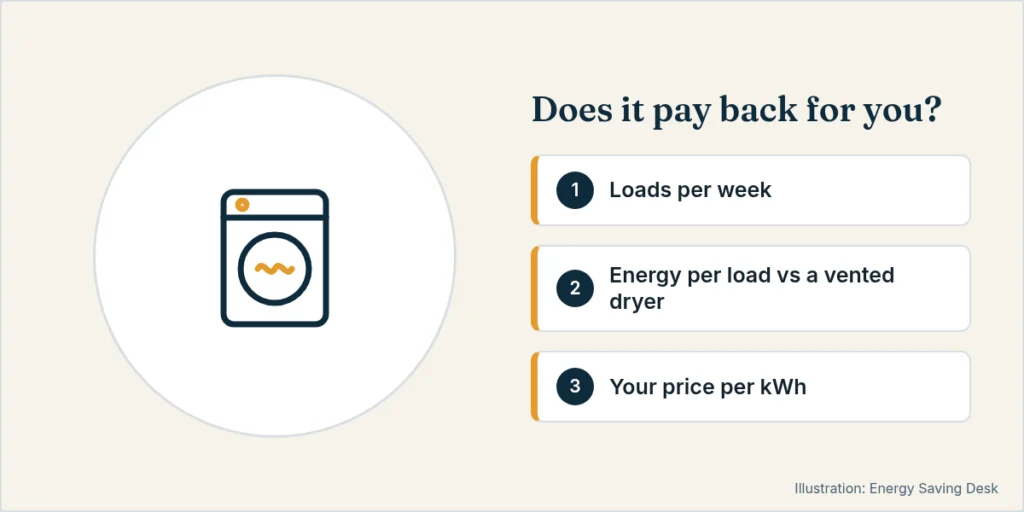
A simple way to estimate your savings
Look at the energy figures on the labels of the models you’re comparing (kWh per cycle, or per year on the UK/EU label). Then:
(old kWh per load − new kWh per load) × loads per year × your electricity price
For illustration only: if a heat pump model saves 2 kWh per load and you dry 200 loads a year at the UK’s capped 26.32p/kWh, that’s about £105 a year. At 50 loads a year it’s about £26, and the extra purchase price may never pay back. Big families who dry most of their washing are the clear winners. Occasional users often aren’t. To run the numbers with your own labels, loads and price, try our “is switching worth it?” calculator.
Worked example with tested running costs
Which? measured the energy use of the dryers it tests and costed it at three cotton loads a week (156 a year) at the October 2026 cap of 26.32p/kWh. The average yearly running cost was £139.74 for vented, £138.91 for condenser and £54.32 for heat pump models.
- Saving at 3 loads a week: about £85 a year, roughly 55p a load (around 2.1 kWh).
- At 1 load a week: about £28 a year.
- At 6 loads a week: about £170 a year.
Now the price gap. If the heat pump model you’re looking at costs £300 more than the vented one, it pays back in about 3.5 years at three loads a week, about 1.8 years at six, and about 10.5 years at one. Check the actual price gap between the two models you’re comparing.
Heat pump dryers vary a lot too. Which?’s cheapest heat pump model cost £33.49 a year to run and the dearest £93.73. That’s why the label’s kWh figure is worth reading.
In the US, the same 2.1 kWh a load saving is worth about 38¢ at the average residential rate of 18.16¢/kWh (EIA, August 2026). That’s about $59 a year at three loads a week, so it’s a slower payback than in the UK unless your rate is high.
Who it’s not for
- Occasional users who dry a load a week or less. The premium may never pay back.
- People who mostly line-dry. Drying outside or on an airer costs nothing.
- Cold outbuildings. Heat pump dryers work best in a space that isn’t very cold, rather than an unheated garage in winter.
- Households that need fast turnaround, like a sports kit dried in an hour. Cycles are often longer.
Condenser vs heat pump: an easy mistake
A condenser dryer also needs no vent, but in Which?’s figures it cost about the same to run as a vented one (£138.91 against £139.74 a year). If you want a ventless dryer for convenience, a condenser gets you that. If you want a ventless dryer that also cuts the bill, it has to be a heat pump model.
The trade-offs
In favour:
- Much lower running costs for frequent use.
- No vent hole, so you can put it almost anywhere with power and drainage.
- Lower drying temperatures are gentler on clothes.
Against:
- Higher purchase price.
- Longer cycles, often noticeably longer than a vented dryer.
- Filters (often two) and the condenser area need regular cleaning. Performance drops quickly if you skip this.
- Collected water must go somewhere: either empty the tank, or run the drain hose to a sink or the washer drain.
- Works best in a room that isn’t very cold, such as a heated utility room rather than an unheated garage in winter.
Get the most from one
- Spin harder first. A washer that spins at a higher speed leaves less water for the dryer to remove. ENERGY STAR suggests pairing with an ENERGY STAR certified front-load washer.
- Use the sensor programmes, not timed drying.
- Clean the filters after every load.
- Don’t overload or underload. Both waste energy.
FAQ
Are heat pump dryers slower?
Generally yes. Plan for longer cycles than a vented dryer.
Can I put one in a cupboard?
Often yes, since there’s no vent, but it needs airflow. Check the installation clearances in the manual.
Is a washer-dryer a good alternative?
Combo units save space, but the drying side is usually less efficient unless it’s a heat pump combo.
Related
More guides in Efficient Appliances.
Sources
- ENERGY STAR, heat pump dryers (at least 28% less energy; pair with a certified front-load washer; drainage): https://www.energystar.gov/products/clothes_dryers/heat-pump-dryer
- ENERGY STAR, clothes dryers (certified heat pump dryers use around 70% less energy than conventional dryers): https://www.energystar.gov/products/clothes_dryers
- Ofgem price cap, Oct–Dec 2026: https://www.ofgem.gov.uk/news/changes-energy-price-cap-between-1-october-and-31-december-2026
- Which?, how much does a tumble dryer cost to run (average yearly running costs at three cotton loads a week, October 2026 price cap): https://www.which.co.uk/reviews/tumble-dryers/article/how-much-does-it-cost-to-run-a-tumble-dryer-a5xYt7V21rY0
- U.S. EIA, Electric Power Monthly, Table 5.3 (U.S. average residential price 18.16¢/kWh, August 2026; released October 23, 2026; next release November 24, 2026): https://www.eia.gov/electricity/monthly/epm_table_grapher.php?t=table_5_03