Induction vs Gas Cooktops: Efficiency, Running Cost and the Honest Maths
Last checked: November 10, 2026.
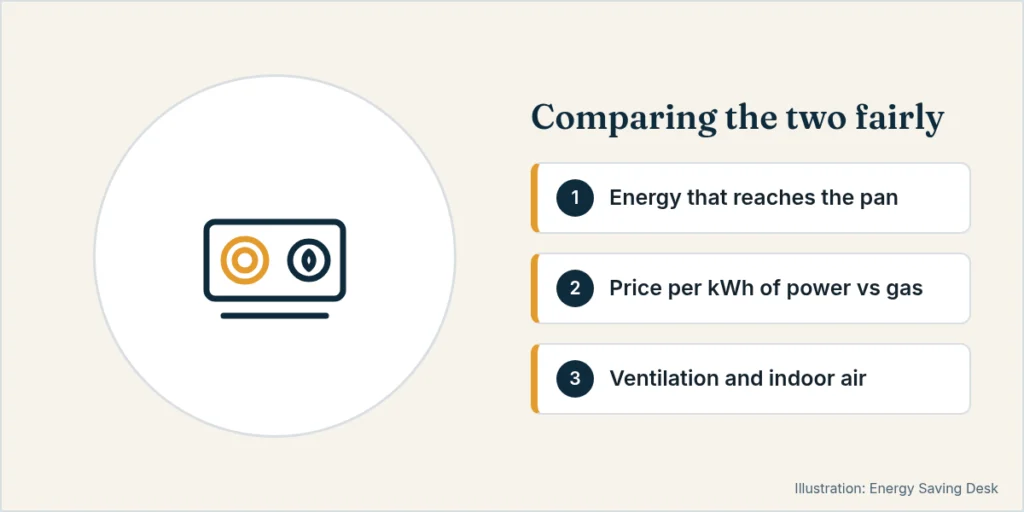
Induction is far more efficient than gas. Much more of the energy ends up in the pan. But efficiency and running cost aren’t the same thing, because electricity costs more per kWh than gas. Here’s what that means in practice, and why cost probably shouldn’t be the deciding factor either way.
How efficient each one is
ENERGY STAR puts cooktop efficiency, meaning the share of heating energy transferred to the cookware, at about:
| Cooktop | Efficiency |
|---|---|
| Induction | about 85% |
| Electric resistance (coil or radiant glass) | about 75–80% |
| Gas | about 32% |
The U.S. Department of Energy describes induction as up to three times more efficient than gas. The rest of a gas flame’s heat goes into your kitchen, which is pleasant in winter and not in summer.
Running cost: closer than you’d think
Example: bringing 1 litre of water from 15 °C to the boil needs about 0.1 kWh of heat.
| Energy bought | Cost at UK capped rates (Oct–Dec 2026) | |
|---|---|---|
| Induction (85%) | about 0.12 kWh electricity | about 3.1p |
| Gas (32%) | about 0.31 kWh gas | about 2.5p |
At UK prices (26.32p/kWh electricity, 7.97p/kWh gas), electricity costs about 3.3× as much as gas, while induction is about 2.7× as efficient. Per use, gas comes out slightly cheaper. If you know your yearly cooking energy, our switching calculator accepts a separate gas and electricity price.
Cooking is a small part of most energy bills either way. The difference is a few pounds a year. The real cost question is different: if your hob is the last gas appliance in the house, going all-electric lets you drop the gas standing charge, worth about £108 a year in the UK at current rates. That usually happens alongside a heat pump.
Reasons people actually switch
- Speed and control: induction boils water fast and responds to changes instantly.
- Safety: there’s no flame, the surface only gets hot from the pan, and most hobs switch off automatically.
- Cleaning: a flat glass top.
- Indoor air: burning gas indoors produces combustion by-products. Use your extractor hood whatever you cook on.
The drawbacks
- Pans: they must be magnetic. If a magnet sticks to the base, it works. Some aluminium and copper pans won’t.
- Wiring: a full-size induction hob or range usually needs a dedicated high-current circuit. Budget for an electrician. Some US models are designed for a standard 120 V outlet, with lower power.
- Upfront cost: usually higher than a basic gas hob, although prices have dropped a lot.
- Power cuts: no cooking without power, unless you have backup. A single-zone plug-in induction plate on a power station is a stopgap, but it drains a 1 kWh unit quickly.
Worked example: a year of boiling water
Boil 1 litre twice a day for a year, 730 boils, at the UK capped rates above:
- Induction: 730 × about 3.1p ≈ £22.60
- Gas: 730 × about 2.5p ≈ £18.30
That’s about £4 a year in gas’s favour. Even at three times that much cooking it’s around £13. Compare that with the £108 a year gas standing charge you only drop if you leave gas completely.
Replacing a ceramic or radiant electric hob with induction for running cost alone doesn’t add up either. At about 77.5% efficiency the same boil takes about 0.129 kWh (about 3.4p), so induction saves about 0.3p a boil, or around £2 a year in this example. Switch for speed, control and cleaning, not for the bill.
Who should probably keep their current hob for now
- You’re keeping gas for heating anyway. Induction will cost slightly more to run and won’t drop the standing charge.
- Your wiring needs an expensive upgrade, such as a new consumer unit or a long cable run. Get a quote before you buy the hob.
- Most of your pans aren’t magnetic. Add the cost of replacing them.
- You often lose power and have no backup.
- You cook a lot with a round-bottomed wok. It barely touches a flat glass top. A flat-bottomed wok or a dedicated wok zone helps.
If you do switch: what to budget for
- The hob or range itself.
- A dedicated circuit, and possibly a consumer unit or panel upgrade. Get the electrician’s quote first.
- Magnetic pans, if yours aren’t.
- Safely disconnecting and capping the gas supply to the old hob, done by a registered engineer (Gas Safe in the UK).
- Making good the worktop if the cut-out size differs.
Cooking costs won’t pay for any of this. The standing charge saving only arrives when the hob is your last gas appliance.
Low-commitment way to try it
A single portable induction plate lets you test the cooking style with your own pans before replacing the hob.
FAQ
Is induction cheaper to run than gas?
Per use, usually not at current UK prices. It’s close, and the difference is small. You only save meaningfully if you disconnect gas completely.
Does induction work with cast iron?
Yes. Cast iron is magnetic. Lift it rather than sliding it to avoid scratching the glass.
Is induction safe with a pacemaker?
Ask your doctor or the device maker.
Related
More guides in Efficient Appliances.
Sources
- U.S. DOE, making the switch to induction: https://www.energy.gov/articles/making-switch-induction-stoves-or-cooktops
- California induction range study (efficiency testing), 2019: https://www.caetrm.com/media/reference-documents/Induction-Range-Final-Report-July-2019.pdf
- ENERGY STAR, electric cooking products (induction): https://www.energystar.gov/products/electric_cooking_products
- ENERGY STAR Emerging Technology Award, residential induction cooking tops (~85% induction, ~75–80% resistance, ~32% gas): https://www.energystar.gov/partner-resources/products_partner_resources/brand-owner/eta-consumers/res-induction-cooking-tops
- Ofgem price cap, Oct–Dec 2026 (Direct Debit averages 26.32p/kWh electricity and 7.97p/kWh gas; gas standing charge 29.68p/day): https://www.ofgem.gov.uk/news/changes-energy-price-cap-between-1-october-and-31-december-2026