How Much Does It Cost to Charge an EV at Home? (UK and US, 2026)
Last checked: November 13, 2026. Prices come from Ofgem, Octopus Energy, Zapmap, the U.S. EIA, PG&E and Paren, and car efficiency from the EPA’s fueleconomy.gov. The worked examples are our own calculations with labelled assumptions. We don’t earn anything from the links in this guide (affiliate disclosure).
Charging at home is the single biggest reason EVs are cheap to run. But “cheap” covers a huge range. On the right tariff, a British driver can pay under 2p a mile. Relying on rapid chargers can cost more per mile than a petrol car. This guide works out the cost per mile, per month and per year for typical drivers in Great Britain and the US, using current prices.
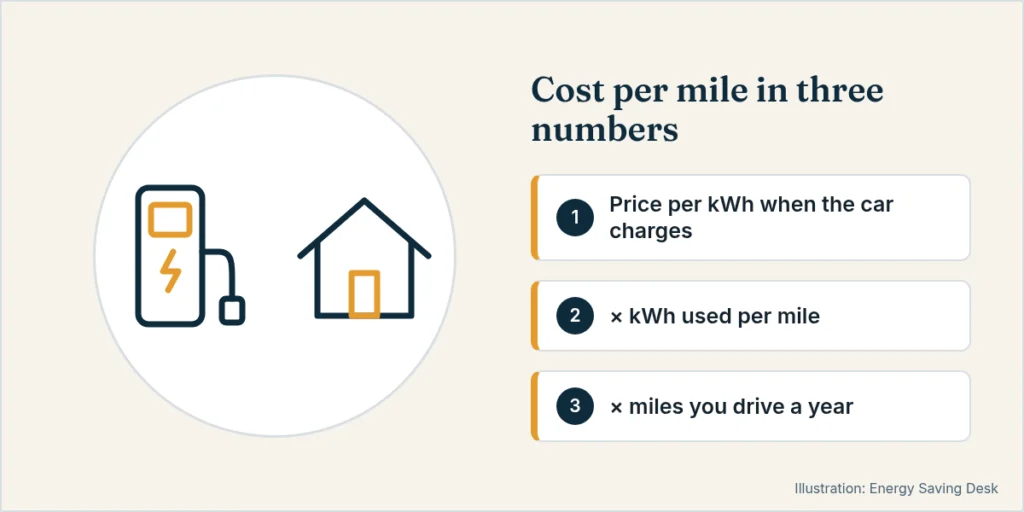
The formula
Cost per mile = price per kWh × kWh used per mile
- Price per kWh: the rate you actually pay when the car charges. On a time-of-use tariff, that’s the off-peak rate, provided the car charges in that window.
- kWh per mile: in the US, read it from the EPA label as kWh per 100 miles. The EPA says its electric ratings include charging losses, assuming Level 2 charging, so they reflect the energy drawn from the wall. In the UK, the car’s trip computer usually shows miles per kWh. Divide 1 by that number to get kWh per mile.
Then: yearly cost = cost per mile × miles a year.
Great Britain: what a mile costs on each option
Assumptions: a car averaging 3.4 miles per kWh, which is what Zapmap’s own “average efficiency EV” works out to, and 7,000 miles a year (our assumption; check your MOT history for your own figure).
| How you charge | Price per kWh | Cost per mile | Per month | Per year (7,000 miles) |
|---|---|---|---|---|
| Home, smart EV tariff (Intelligent Octopus Go) | from 6.5p | 1.9p | ~£11 | ~£134 |
| Home, Octopus Go off-peak (London, Nov 2026) | 9.40p | 2.8p | ~£16 | ~£194 |
| Home, standard price cap rate (Oct–Dec 2026) | 26.32p | 7.7p | ~£45 | ~£542 |
| Public standard chargers, PAYG average (Oct 2026) | 54p | 15.9p | ~£93 | ~£1,112 |
| Tesla Superchargers open to all, average (Oct 2026) | 69p | 20.3p | ~£118 | ~£1,421 |
| Public rapid/ultra-rapid, PAYG average (Oct 2026) | 82p | 24.1p | ~£141 | ~£1,688 |
| For comparison: petrol car at 45 mpg (assumed), 170.71p a litre | n/a | 17.2p | ~£101 | ~£1,207 |
The petrol price is the UK pump price of unleaded for the week of November 9, 2026, from the government’s weekly fuel price statistics. The 45 mpg (imperial) figure is our assumption. Ofgem announces the January–March 2027 price cap on November 25, 2026, so the 26.32p row applies until December 31, 2026.
What stands out:
- The tariff matters more than the car. Switching from the standard rate to an EV tariff saves about £350–400 a year at 7,000 miles.
- Public rapid charging costs more per mile than petrol at these averages. Zapmap notes many drivers pay less than PAYG prices through memberships and promotions, so check your own network.
- A realistic mix: 80% of miles charged at home on Octopus Go and 20% on rapid chargers works out to about 7.0p a mile, or £492 a year.
The US: what a mile costs
Assumptions: 12,000 miles a year (our assumption) and two common crossovers on their 2026 EPA labels: the Tesla Model Y Long Range AWD (27 kWh per 100 miles) and the Chevrolet Equinox EV FWD (31 kWh per 100 miles).
| How you charge | Price per kWh | Model Y cost per mile | Model Y per year | Equinox EV per year |
|---|---|---|---|---|
| Home, US average residential price (Aug 2026) | 18.16¢ | 4.9¢ | ~$588 | ~$676 |
| Home, PG&E E-TOU-C winter off-peak (California) | 36.757¢ | 9.9¢ | ~$1,191 | ~$1,367 |
| Tesla Supercharger, member price (Q3 2026 average) | 39.6¢ | 10.7¢ | ~$1,283 | ~$1,473 |
| Public DC fast charging, off-peak time-of-use (Q3 2026 avg) | 43.8¢ | 11.8¢ | ~$1,419 | ~$1,629 |
| Public DC fast charging, national average (Q3 2026) | 54.0¢ | 14.6¢ | ~$1,750 | ~$2,009 |
| For comparison: 2026 Toyota RAV4 AWD XLE hybrid, 41 mpg, $3.995/gal | n/a | 9.7¢ | ~$1,169 | n/a |
The PG&E row uses the above-baseline winter rate. Use within your baseline allowance gets an 8.14¢ credit. The gasoline price is the EIA’s US regular average for the week of November 9, 2026.
What stands out:
- At the national average price, home charging costs about half as much per mile as a 41 mpg hybrid.
- In high-price states the gap shrinks. On PG&E’s E-TOU-C off-peak rate, a Model Y costs about the same per mile as that hybrid. PG&E also offers a dedicated EV plan (EV2-A), so compare it with E-TOU-C before you decide.
- Public DC fast charging costs more per mile than the hybrid at Paren’s Q3 2026 averages. Fast charging is for road trips, not for daily driving.
Is a home charger worth it?
Here’s a British example. Octopus quotes smart chargers from £949 including standard installation. Moving 7,000 miles a year from public standard chargers (54p) to Octopus Go off-peak (9.40p) saves:
(54 − 9.40)p × (7,000 ÷ 3.4) kWh ≈ £918 a year
That pays back the charger in about a year. If you’d otherwise charge from a standard 3-pin socket at home on the price cap rate, the payback comes from the cheaper tariff instead. A smart charger is often what makes those tariffs available, because suppliers need to control the charging times.
In the US, many drivers manage on a 120 V Level 1 cord for short daily mileage. The federal Alternative Fuels Data Center notes that Level 1 can meet many drivers’ daily needs if an outlet on a dedicated circuit is near the parking spot. See our home EV charger buying guide for when Level 2 is worth it.
Charging from your own solar
Solar power that would otherwise be exported costs you whatever you’d have been paid for it. In Great Britain, with Octopus’s Outgoing export rate of 12p, that’s about 3.5p a mile. That’s more than charging overnight on an EV tariff, so solar charging is best for homes on flat rates, or with low export payments.
A solar-aware charger, or the solar mode on a smart charger, needs about 1.4 kW of surplus to start on a single-phase supply. Our smart solar devices guide explains how it works.
Pros and cons of charging at home
Pros
- Lowest cost per mile by a wide margin on an EV or time-of-use tariff
- No detours, waiting or app-juggling
- Lets you use your own solar power or cheap overnight rates
Cons
- Needs off-street parking, or a legal cable solution, and often a charger installation
- The cheap rate only applies if charging really happens in the cheap window
- Higher daytime rates on some EV tariffs (34.53p in London on Octopus Go) can raise the rest of your bill unless you shift other use too
Who these numbers don’t fit
- Drivers without off-street parking pay public prices, so the bottom rows of each table are your real cost. Look for membership or off-peak deals.
- Very high-mileage drivers charge more often on the road, so weight the public rows more heavily.
- Cold-climate drivers see higher kWh per mile in winter, because heating the cabin and battery uses energy.
FAQ
How much does a full charge cost at home?
Multiply the energy you add by your price. Adding 60 kWh (our example) costs about £5.64 at Octopus Go’s 9.40p, £15.79 at the price cap’s 26.32p, or $10.90 at the US average of 18.16¢. Charging losses add a little on top when you measure at the battery.
Is it cheaper to charge an EV than to fill up with petrol?
At home, yes, by a wide margin at current prices. On public rapid chargers at PAYG prices it often isn’t, in either Great Britain or the US.
Does an EV tariff raise the rest of my bill?
It can. Octopus Go’s London day rate was 34.53p in October 2026, against the 26.32p price cap. If you can’t move other use into the night, compare your whole bill, not just the car.
What’s the cheapest time to charge on a dynamic tariff?
Usually overnight or in sunny, windy middays. On Agile Octopus in London in October 2026, the cheapest 4-hour block overnight averaged about 20.6p, which is far more than a dedicated EV tariff’s off-peak rate. Dynamic tariffs vary a lot from month to month.
Related guides
- Home EV charger buying guide (US and UK)
- Is a home battery worth it on a time-of-use tariff?
- Smart solar devices: run more of your home on your own solar
- How many solar panels do I need?
- Is switching worth it? Savings and payback calculator
More guides in EV Charging.
Sources
All checked on November 13, 2026.
- Ofgem, price cap 1 October–31 December 2026: https://www.ofgem.gov.uk/news/changes-energy-price-cap-between-1-october-and-31-december-2026
- Octopus Energy, Intelligent Octopus Go (from 6.5p/kWh; chargers from £949 installed): https://octopus.energy/smart/intelligent-octopus-go/
- Octopus Energy public tariff API (Go and Agile rates, Outgoing export rate; London region C): https://api.octopus.energy/v1/products/
- Zapmap, EV Charging Price Index (October 2026 data, updated November 5, 2026): https://www.zapmap.com/ev-stats/charging-price-index
- GOV.UK, weekly road fuel prices (week of November 9, 2026, published November 10, 2026): https://www.gov.uk/government/statistics/weekly-road-fuel-prices
- fueleconomy.gov, 2026 Tesla Model Y Long Range AWD: https://www.fueleconomy.gov/feg/noframes/49744.shtml
- fueleconomy.gov, 2026 Chevrolet Equinox EV FWD: https://www.fueleconomy.gov/feg/noframes/49953.shtml
- fueleconomy.gov, 2026 Toyota RAV4 AWD XLE (hybrid): https://www.fueleconomy.gov/feg/noframes/50136.shtml
- U.S. EPA, fuel economy and EV range testing (ratings include charging losses, Level 2 assumed): https://www.epa.gov/greenvehicles/fuel-economy-and-ev-range-testing
- U.S. EIA, Electric Power Monthly Table 5.3 (August 2026, released October 23, 2026): https://www.eia.gov/electricity/monthly/epm_table_grapher.php?t=table_5_03
- U.S. EIA, gasoline and diesel fuel update (week of November 9, 2026, released November 10, 2026): https://www.eia.gov/petroleum/gasdiesel/
- PG&E Electric Schedule E-TOU-C (rates effective June 1, 2026): https://www.pge.com/tariffs/assets/pdf/tariffbook/ELEC_SCHEDS_E-TOU-C.pdf
- Paren, US EV Fast Charging Q3 2026 (pricing section): https://www.paren.app/reports/us-ev-fast-charging-q3-2026
- U.S. DOE Alternative Fuels Data Center, charging EVs at home: https://afdc.energy.gov/fuels/electricity-charging-home