
Is a Home Battery Worth It on a Time-of-Use or Dynamic Tariff? The Arbitrage Maths
Last checked: November 13, 2026. Tariff figures come from the suppliers’ and regulators’ own pages and price data (the worked examples use October 2026 prices), and the worked examples are our own calculations. We haven’t tested these batteries, and we don’t earn anything from the links in this guide (affiliate disclosure).
A battery on a time-of-use or dynamic tariff does one simple thing: it buys electricity when it’s cheap, stores it, and lets your home use it when it’s expensive. That’s called arbitrage. Whether it pays depends on three numbers, and only one of them is in the sales brochure.
This guide shows the formula, then runs it on real tariffs: Octopus Go and Agile in Great Britain, a Dutch dynamic contract and PG&E’s E-TOU-C plan in California. The short answer: a battery can earn its keep on a tariff with a big, reliable gap between cheap and peak hours. On a tariff with a small gap, losses and battery wear eat most or all of the saving.
The three numbers that decide it
1. The spread. The difference between the price you charge at and the price you avoid. Use your actual tariff, not a national average.
2. Round-trip efficiency. You never get back all the electricity you put in. Some is lost as heat in the inverter and cells. Big installed batteries are usually quoted at around 90%. Smaller units can be lower: HomeWizard says its Plug-In Battery averages between 70% and 85% in real use.
3. Wear. Every full cycle uses up a little of the battery’s life. Spread the purchase price over all the kWh it will ever deliver and you get a “cost per kWh stored” that the spread has to beat.
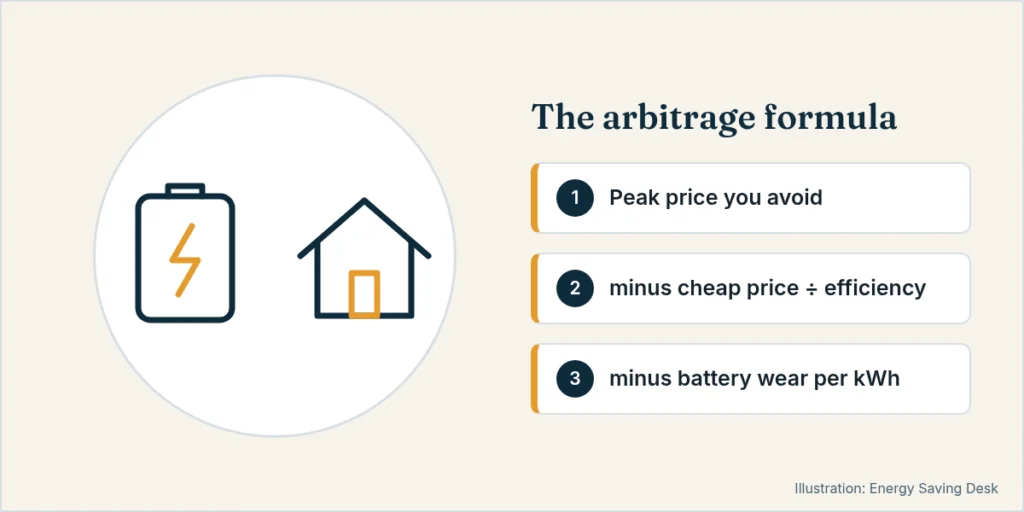
The saving on each kWh the battery delivers is:
Saving per kWh = peak price − (cheap price ÷ round-trip efficiency)
The cheap price is divided by efficiency because you have to buy more than 1 kWh to get 1 kWh back out. At 90%, you buy about 1.11 kWh for every 1 kWh delivered.
Then multiply by how many kWh you actually shift per day. This is where many estimates go wrong. A 10 kWh battery doesn’t save on 10 kWh a day unless your home really uses 10 kWh in the expensive hours.
Worked example 1: Octopus Go (Great Britain, EV households)
Octopus Go is Octopus Energy’s EV tariff, with a cheap rate between 00:30 and 05:30 every night. In the London region in October 2026 its rates were 9.40p/kWh off-peak and 34.53p/kWh at all other times, from Octopus’s own public price data. They were unchanged when we checked on November 13, 2026.
- Saving per kWh at 90% efficiency: 34.53 − (9.40 ÷ 0.9) = 34.53 − 10.44 = 24.1p
- Assumption: the battery covers 6 kWh a day of daytime and evening use
- 6 × 24.1p = £1.45 a day, or about £527 a year
Octopus quotes £5,336 for a 10 kWh battery-only installation (April 2026 prices on its battery-only page). That gives a simple payback of about 10 years, before any repairs.
The catch: the 34.53p day rate is higher than the price cap’s 26.32p, so Go only makes sense if most of your use moves into the cheap window. A battery is exactly what does that. With an EV on the tariff anyway, this is the strongest case in this guide.
Worked example 2: Agile Octopus (half-hourly prices)
Agile prices change every half hour and follow the wholesale market. We pulled every half-hourly London-region price for October 2026 from Octopus’s public API:
- The cheapest 4-hour block between midnight and 7 a.m. averaged 20.6p/kWh
- The 4–7 p.m. peak averaged 46.6p/kWh
- Three days had at least one negative-price slot, when you’re paid to use power
So the saving on each kWh moved out of the peak was 46.6 − (20.6 ÷ 0.9) = 23.8p. That sounds as good as Go, but the peak is only three hours long. If your home uses 2.5 kWh between 4 and 7 p.m. (our assumption), that’s about £217 a year.
The less flattering comparison is with simply staying on a standard tariff. We modelled a home using 2,500 kWh a year (Ofgem’s “medium” typical use) with 2.5 kWh a day in the peak and the rest spread over the day. In October 2026:
- On Agile with no battery, its energy cost about 32.7p per kWh on average, more than Octopus’s own flexible rate of 26.6p, because the evening peak was so expensive
- On Agile with a battery charging overnight and covering everything, it cost about £1.57 a day, against £1.82 on the flexible rate: a saving of only about £93 a year compared with not switching at all
October 2026 was a high-price month with VAT removed from electricity bills, so treat these as one month’s snapshot, not an annual forecast. Spring and summer usually bring more cheap and negative slots. The lesson holds, though: on Agile the battery is what makes the tariff work, and the saving against a plain tariff can be small.
Worked example 3: a Dutch dynamic contract
Dutch dynamic contracts pass on the hourly or quarter-hourly day-ahead price, plus a supplier markup, energy tax and VAT. We took every NL day-ahead price for October 2026 from the Energy-Charts data service (data from Bundesnetzagentur/SMARD):
- Cheapest 4-hour block of the day: 11.1 ct/kWh on average (before tax)
- 5–9 p.m. evening peak: 23.4 ct/kWh on average (before tax)
Add an assumed supplier markup of 2 ct, the 2026 energy tax of €0.09161/kWh and 21% VAT, and you pay about 26.9 ct in the cheap block and 41.9 ct at the peak. The energy tax is the same at both times, so it only matters through the losses.
- At 90% efficiency: 41.9 − (26.9 ÷ 0.9) = 12.0 ct per kWh
- At 80% (closer to a small plug-in battery): 41.9 − (26.9 ÷ 0.8) = 8.2 ct
A HomeWizard Plug-In Battery has a list price of €1,195 (on offer at €1,075 when we checked on November 13, 2026) for 2.7 kWh, and discharges at up to 800 W. If it delivers 2.4 kWh a day at 8.2 ct, that’s about €72 a year, a payback of roughly 16–17 years at list price (about 15 at the offer price) from grid arbitrage alone. HomeWizard’s own estimate of about €280 a year assumes it’s mostly storing your own solar power. That matters more from January 1, 2027, when Dutch net metering (salderen) ends.
Worked example 4: PG&E E-TOU-C (California)
PG&E’s E-TOU-C plan charges more from 4 to 9 p.m. every day. Its tariff sheet effective June 1, 2026 lists:
- Summer (June–September): $0.52240 peak, $0.39940 off-peak
- Winter (October–May): $0.39757 peak, $0.36757 off-peak
Summer saving at 90% efficiency: 52.24 − (39.94 ÷ 0.9) = 7.9¢ per kWh. Winter: 39.757 − (36.757 ÷ 0.9) = −1.1¢. In winter, charging from the grid to cover the peak loses money, because the 3¢ spread is smaller than the 10% lost on the way. On this plan a battery is a solar and backup purchase, not an arbitrage one.
Side by side
| Tariff (data period) | Cheap price | Peak price | Saving per kWh delivered (90%) | Example kWh/day | Rough yearly saving |
|---|---|---|---|---|---|
| Octopus Go, London (Oct 2026) | 9.40p | 34.53p | 24.1p | 6 | ~£527 |
| Agile Octopus, London (Oct 2026) | 20.6p (cheapest 4 h) | 46.6p (4–7 p.m.) | 23.8p | 2.5 | ~£217 vs Agile without a battery |
| Dutch dynamic (Oct 2026, incl. tax) | ~26.9 ct | ~41.9 ct | 12.0 ct (8.2 ct at 80%) | 2.4 | ~€72 at 80% |
| PG&E E-TOU-C summer | $0.3994 | $0.5224 | 7.9¢ | 5 | ~$48 for the 4 summer months |
| PG&E E-TOU-C winter | $0.36757 | $0.39757 | −1.1¢ | None | Loses money |
The PG&E summer figure assumes 5 kWh a day for 122 days. All yearly figures leave out standing charges, which differ between tariffs. They’re also before battery wear.
Don’t forget wear: the cost per kWh stored
Take Octopus’s 10 kWh price of £5,336 for a 10.24 kWh Fox ESS EVO. If it does one full cycle a day for 10 years at 90% efficiency, it delivers about 33,600 kWh. That’s about 15.9p of battery cost for every kWh it gives back.
For HomeWizard’s unit, the swap service covers up to 4,000 cycles. 4,000 × 2.7 kWh × 0.8 works out at about €0.14 per kWh.
Compare those with the spreads above. On Go, 24p of saving against roughly 16p of wear leaves a real margin. In the Netherlands, an 8–12 ct grid-only spread doesn’t cover 14 ct of wear. The battery only pays there if it also stores solar that would otherwise be exported for little.
Pros and cons of buying a battery for tariff arbitrage
Pros
- Works without solar panels, so it suits flats and shaded roofs (installed systems need network approval)
- Saves automatically once set up, especially on fixed-window tariffs like Go
- Can add backup power, depending on the model. HomeWizard’s plug-in battery switches off in a power cut, as most plug-in batteries do
- A larger spread from future peaks or negative prices helps it more
Cons
- Savings depend on tariffs that can change at short notice. Agile and dynamic prices can also spike
- Efficiency losses of 10–30% come off every kWh
- Wear cost is often similar to the saving per kWh
- Most homes use far less in peak hours than the battery holds
Who it’s not for
- Low evening users. If you use under 2 kWh between 4 and 9 p.m., even a small battery sits half idle.
- Anyone on a flat rate who won’t switch tariff. A battery saves nothing on a flat price unless it stores solar.
- PG&E E-TOU-C customers buying for arbitrage alone. The winter spread is negative after losses.
- Renters planning to move soon. A plug-in battery moves with you, but a wall-mounted one doesn’t.
How to check your own numbers in 10 minutes
- Download a year of half-hourly or hourly usage from your supplier or smart-meter app.
- Add up how many kWh you use in your tariff’s peak hours on a typical day. That’s your realistic daily shift.
- Run the formula above with your own rates, then subtract the wear cost per kWh.
- Put the result into our home battery payback calculator to see the years to payback.
FAQ
Can a battery make money by exporting at peak times?
Sometimes. On Octopus Flux (for homes with solar and a battery), the London export rate from 4 to 7 p.m. was 30.31p in late October 2026, and the 2–5 a.m. import rate was 16.17p. That leaves 12.3p per kWh at 90% efficiency, before wear. That’s thin, so most owners use stored power at home first.
Is a bigger battery always better on a dynamic tariff?
No. The saving is capped by how much you use in the expensive hours and by how fast the battery can discharge. HomeWizard’s single unit, for example, discharges at 800 W, which isn’t enough to cover an oven.
Does round-trip efficiency really matter that much?
Yes, when spreads are small. On PG&E’s winter prices, going from 90% to 100% efficiency would turn a 1.1¢ loss into a 3¢ gain. On Octopus Go it barely matters, because the spread is wide.
Should I wait for the end of Dutch net metering?
From January 1, 2027, Dutch solar owners can no longer offset exports against imports, and export payments must be at least 50% of the bare supply price until 2030. That improves the battery case for solar owners, but grid arbitrage alone still looks thin on October 2026 prices.
Related guides
- Best home batteries for solar in the UK
- Australia’s Cheaper Home Batteries Program explained
- Smart solar devices: run more of your home on your own solar
- How many solar panels do I need?
- Home battery payback calculator
More guides in Solar & Batteries.
Sources
All checked on November 13, 2026. October 2026 price data was downloaded on November 1, 2026 and re-checked on November 13.
- Ofgem, energy price cap 1 October–31 December 2026 (26.32p/kWh, VAT removed): https://www.ofgem.gov.uk/news/changes-energy-price-cap-between-1-october-and-31-december-2026
- Ofgem, review of typical domestic consumption values (2,500 kWh medium from July 1, 2026): https://www.ofgem.gov.uk/sites/default/files/2026-05/Review%20of%20typical%20domestic%20consumption%20values%20decision.pdf
- Octopus Energy public tariff API (Go, Agile, Flexible, Flux rates, London region C, October 2026): https://api.octopus.energy/v1/products/
- Octopus Energy, Agile Octopus: https://octopus.energy/smart/agile/
- Octopus Energy, Intelligent Octopus Go: https://octopus.energy/smart/intelligent-octopus-go/
- Octopus Energy, battery-only installation prices (April 2026): https://octopus.energy/blog/battery-only-installation/
- Energy-Charts (Fraunhofer ISE), NL day-ahead prices, October 2026 (data Bundesnetzagentur/SMARD.de, CC BY 4.0): https://api.energy-charts.info/
- Belastingdienst, energy tax rates 2026: https://www.belastingdienst.nl/wps/wcm/connect/bldcontentnl/belastingdienst/zakelijk/overige_belastingen/belastingen_op_milieugrondslag/energiebelasting/energiebelasting
- Rijksoverheid, net metering ends in 2027: https://www.rijksoverheid.nl/themas/klimaat-milieu-en-natuur/energie-thuis/salderingsregeling
- ACM ConsuWijzer, exporting after January 1, 2027: https://consument.acm.nl/elektriciteit-en-gas/duurzame-energie/wat-is-salderen
- HomeWizard Plug-In Battery (price, capacity, efficiency, warranty): https://www.homewizard.com/plug-in-battery/
- PG&E Electric Schedule E-TOU-C (rates effective June 1, 2026): https://www.pge.com/tariffs/assets/pdf/tariffbook/ELEC_SCHEDS_E-TOU-C.pdf