How Long Will a Power Station Run a Refrigerator?
Last checked: October 29, 2026. Reviewed and expanded on October 31, 2026.
Short answer: a 1 kWh power station will usually keep a modern, efficient fridge running for somewhere between half a day and a full day. A 2 kWh unit roughly doubles that. The exact figure depends on your fridge, the room temperature, how often the door opens and how much energy the power station itself uses. Here is how to work it out for your own kitchen.
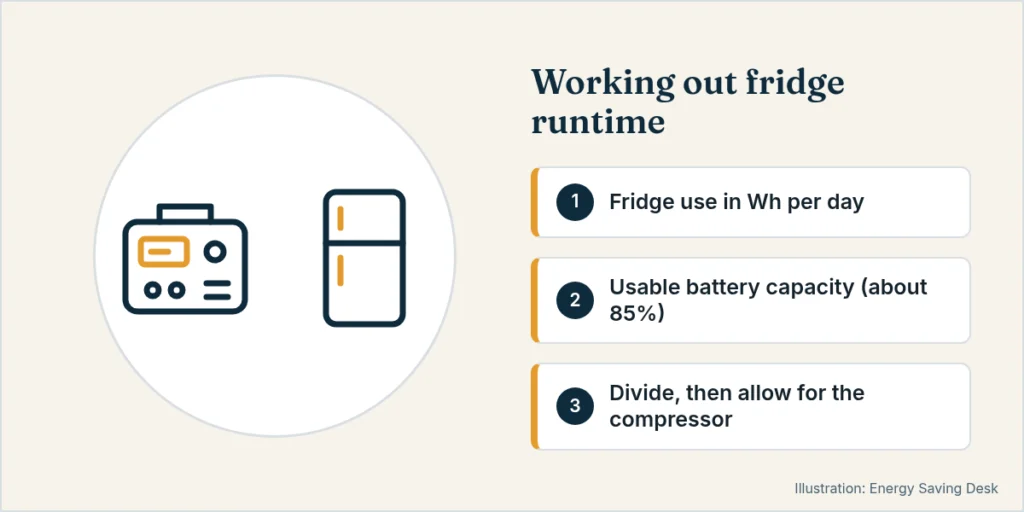
Step 1: Find out how much energy your fridge uses per day
Ignore the wattage on the label for now. A fridge’s compressor switches on and off, so what matters is the energy it uses across a day.
- A new ENERGY STAR full-size refrigerator (18 cubic feet, top freezer) is rated at about 364 kWh a year, or roughly 1.0 kWh per day (U.S. Department of Energy).
- The DOE’s average for refrigerator-freezers in U.S. homes is 588 kWh a year, about 1.6 kWh per day.
- Older fridges use considerably more. The DOE says new ENERGY STAR models cost about half as much to run as pre-1993 units.
You can find your own figure in three ways:
- The energy label. In the US, the yellow EnergyGuide label gives kWh per year. In the UK and EU, the energy label also shows annual kWh. Divide by 365.
- A plug-in energy meter. Leave it on for 24–48 hours with normal use. This is the most accurate method because it reflects your kitchen and your habits.
- The power station’s own display. Many show watts in and out. Watch it over a few hours to get an average.
Step 2: Work out how much energy the power station can actually deliver
The capacity on the box is the size of the battery, not the AC energy you get at the socket. Some is lost turning DC into AC. As a rule of thumb, plan on about 75–85% of the rated capacity. BLUETTI’s own runtime formula for its AC180 uses 90% depth of discharge × 85% inverter efficiency, which is about 77%. BLUETTI also warns that the formula is only a rough guide for compressor loads like fridges.
Then account for the inverter’s own consumption. Jackery, for example, lists the Explorer 2000 v2’s standby draw as 18 W. Over 24 hours that is around 430 Wh, used just by keeping the AC output switched on. Not every model draws that much, but it is the reason real-world runtimes are often shorter than simple sums suggest.
Step 3: Do the sum
Runtime in hours = usable energy (Wh) ÷ (fridge energy per hour + inverter overhead per hour). Or let our power station calculator do the sum for your fridge and anything else you want to run.
Worked example with a 1,024 Wh unit:
- Usable energy at 80%: about 820 Wh
- Efficient fridge at 1.0 kWh/day: about 42 Wh per hour
- Inverter overhead (assume 10 W): 10 Wh per hour
- 820 ÷ 52 = about 16 hours
With an average fridge-freezer at 1.6 kWh/day (about 67 Wh per hour), the same unit gives about 11 hours (820 ÷ 77). A 2,042 Wh unit like the Jackery Explorer 2000 v2 with its 18 W standby gives roughly 1,630 Wh usable ÷ (67 + 18) = about 19 hours.
These are estimates, not test results. Use them to choose a size, then check against your own meter readings.
Step 4: Check the start-up surge
When a compressor starts it draws a short spike of power, often several times its running draw. The power station’s surge (peak) rating needs to cover that, and its continuous rating needs to cover the fridge plus anything else running at the same time. Every 1 kWh-class LFP model in our power station guide has a continuous rating of at least 1,800 W, which is plenty for a domestic fridge. Smaller 300 Wh units with a 300–600 W inverter may struggle.
How to make it last longer
- Keep the doors shut. A full, closed fridge holds its temperature for hours. The USDA says a closed refrigerator keeps food safe for up to 4 hours during a power cut, and a full freezer holds for about 48 hours (24 if half full).
- Run it in shifts. Power the fridge for an hour, then switch it off for an hour or two while you keep the door closed. Check the temperature with a fridge thermometer and keep it at 40 °F (4 °C) or below.
- Turn the AC output off when nothing needs it. This cuts inverter standby losses.
- Recharge during the day from solar panels or a car if the outage is long.
- Chest freezers are efficient. The DOE notes they are often more efficient than uprights, and they hold the cold well with the lid shut.
When you may not need a power station for the fridge
Compare the sums above with how long your outages actually last. The USDA says a closed fridge keeps food safe for up to 4 hours, and a full freezer for about 48 hours (24 if half full). If your outages are usually shorter than that, keeping the doors shut does the job for free. A power station then mostly buys peace of mind, or keeps medical devices and the internet running.
A power station makes most sense when outages regularly run past 4 hours, when you store medicine that has to stay cold, or when you’ll also use it for a CPAP, camping or work. If outages often last more than a day, the worked example shows that even 2 kWh won’t cover a fridge-freezer alone. Look at solar recharging, a generator or hybrid setup, or an expandable unit.
Related guides
- Jackery vs BLUETTI for power outages
- Portable power station vs generator
More guides in Power Stations & Portable Power.
Sources
- U.S. DOE, Purchasing energy-efficient residential refrigerators: https://www.energy.gov/cmei/femp/purchasing-energy-efficient-residential-refrigerators
- U.S. DOE, Refrigerator-freezer RFI FAQ (average annual use): https://www.energy.gov/cmei/buildings/articles/refrigerator-freezer-ec-rfi-faq
- U.S. DOE, Guide to kitchen appliances: https://www.energy.gov/sites/prod/files/guide_to_kitchen_appliances.pdf
- BLUETTI AC180 FAQ (runtime formula): https://www.bluettipower.com/products/ac180
- Jackery Explorer 2000 v2 basic information: https://faq.jackery.com/hc/en-us/articles/52303644507803-Explorer-2000-V2-Basic-Information
- USDA FSIS, food safety during a power outage: https://www.fsis.usda.gov/food-safety/safe-food-handling-and-preparation/emergencies/keep-your-food-safe-during-emergencies