Smart Thermostats for Heat Pumps: What Actually Helps (and What Doesn’t)
Last checked: November 10, 2026.
A smart thermostat that saves money on a gas boiler can cost you money on a heat pump. Boilers like to fire hard and switch off. Heat pumps like to run long and gently at the lowest water or air temperature that keeps you comfortable. Aggressive setbacks, or a thermostat that switches the heat pump on and off like a boiler, work against that.
Here’s how to choose controls that help, split by the two very different worlds of heat pumps.
UK and Europe: air-to-water heat pumps with radiators
Start with what the heat pump already has
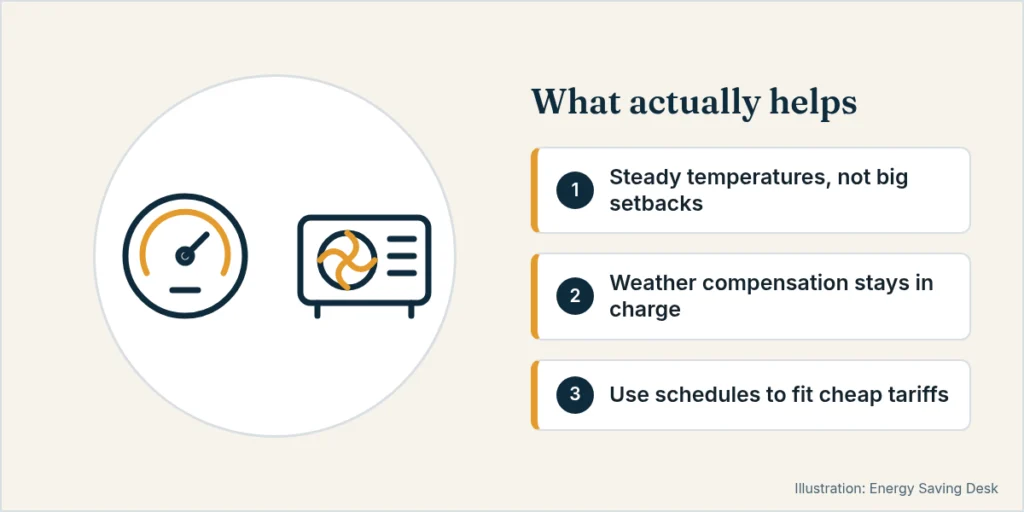
Most air-to-water heat pumps come with their own controller and weather compensation: the heat pump lowers its flow temperature when it’s mild outside and raises it when it’s cold. Set up properly, this does most of the efficiency work. A room thermostat can still act as a comfort limit; using it to switch the heat pump on and off like a boiler can work against the weather-compensation curve.
Where a smart thermostat fits
- A heat pump-specific smart system can read and adjust the heat pump directly. tado, for example, sells a Heat Pump Optimizer X designed for this, with compatibility depending on the heat pump brand and model.
- Generic boiler smart thermostats switch the heat pump on and off like a boiler’s call for heat. That can work, but it overrides the modulation that makes heat pumps efficient. Use them with gentle schedules, not large setbacks.
- OpenTherm is a manufacturer-independent communication protocol between modulating heating appliances and room thermostats. It isn’t weather compensation in itself, and support varies by heat pump. Check before relying on it.
Settings that usually help
- Small or no night setbacks, because reheating from cold often forces a higher flow temperature.
- Long, steady heating periods instead of short bursts.
- Hot water scheduled for when your tariff is cheap.
US and Canada: ducted heat pumps with backup heat
Here the big risk is auxiliary (aux or emergency) heat: electric resistance strips or a gas furnace that the thermostat can switch on when it thinks the heat pump isn’t keeping up. Resistance heat costs roughly two to three times as much per unit of heat as a heat pump running at an assumed COP of 2–3.
Thermostats such as Google Nest can limit how much backup heat you use. Nest’s Heat Pump Balance feature automatically adjusts the AUX lockout temperature — the outdoor temperature above which the thermostat won’t use backup heat. If that feature is off, or you have a dual-fuel system, you can set the AUX lockout temperature yourself. Other heat-pump thermostats may also have a compressor minimum outdoor temperature, below which the heat pump stops and the backup takes over. Modern cold-climate heat pumps can run well below 0 °F, so check your model’s rating before setting any lockout. A gradual recovery from setbacks also helps, so a morning warm-up doesn’t trigger aux heat.
These settings often sit in installer or advanced menus, and wrong wiring can lock out heat entirely. If you’re not comfortable, ask your HVAC contractor to set them.
Worked example: what auxiliary heat costs (US)
At the U.S. average residential rate of 18.16¢/kWh (EIA, August 2026):
- Resistance strips turn 1 kWh of electricity into 1 kWh of heat, so heat costs about 18¢ per kWh.
- A heat pump at an efficiency (COP) of 3 on a mild day (an assumed figure) costs about 6¢ per kWh of heat. At a COP of 2 on a cold day, it’s about 9¢.
As an illustration, say badly set aux heat supplies 2,500 kWh of heat over a winter that the heat pump could have delivered at a COP of 2.5. The strips cost about $454. The heat pump would have used 1,000 kWh, about $182. That’s roughly $270 wasted, for a thermostat setting.
Who a smart thermostat won’t help much
- Homes where weather compensation is already well set up and someone is in most of the day. The heat pump’s own controller is doing the job.
- Systems designed around a high flow temperature. Fix the design (radiators, flow temperature, heat loss) first. No thermostat makes up for it.
- Renters without permission to change the wiring or controls.
Honest drawbacks: compatibility with heat pumps varies by brand and model, some features rely on a cloud service or a paid plan (check before you buy), and the wrong installer settings can lock out heat or let aux heat run freely.
FAQ
Will a smart thermostat lower my heat pump bills?
It can, mainly by preventing waste (aux heat, heating empty homes) and by working with time-of-use tariffs. It won’t fix a poorly designed system with a high flow temperature. For a rough figure based on your own bill, see our smart thermostat savings calculator.
Should I turn my heat pump off at night?
Usually not. A small setback is fine. A big one often costs more to recover from.
Do I need a heat pump-specific thermostat?
Not always. Check what your heat pump’s own controller offers first, and what it supports for third-party control.
Related
More guides in Heating & Cooling.
Sources
- tado, heat pump products: https://www.tado.com/en/products/heat-pumps
- tado, Heat Pump Optimizer X and compatibility (check brand and model): https://shop.tado.com/en/products/heat-pump-optimizer-x and https://help.tado.com/en/articles/9053843-is-tado-compatible-with-my-heat-pump
- Energy Saving Trust, air source heat pumps (controls and running advice): https://energysavingtrust.org.uk/advice/air-source-heat-pumps/
- U.S. DOE, heat pumps: https://www.energy.gov/heat-pumps
- Google Nest help, Heat Pump Balance and AUX lockout: https://support.google.com/googlehome/answer/9248719?hl=en
- OpenTherm Association, what OpenTherm is: https://www.opentherm.eu/opentherm-protocol/
- U.S. DOE, Cold-Climate Heat Pump Technology Challenge Specification (5 °F and optional −15 °F segments): https://www.energy.gov/sites/default/files/2021-10/bto-cchp-tech-challenge-spec-102521.pdf
- Energy Saving Trust, weather compensation and other controls: https://greenheattoolkit.energysavingtrust.org.uk/t/heat-pump-installers-toolkit/heat-pump-system-design/weather-compensation-and-other-controls/
- ecobee support hub (installer settings vary by model; check before changing them): https://support.ecobee.com/s/
- U.S. EIA, Electric Power Monthly, Table 5.3 (U.S. average residential price 18.16¢/kWh, August 2026; released October 23, 2026; next release November 24, 2026): https://www.eia.gov/electricity/monthly/epm_table_grapher.php?t=table_5_03