Air-to-Air vs Air-to-Water Heat Pumps: Which Fits Your Home?
Last checked: October 29, 2026. Reviewed and expanded on October 31, 2026.
Both types pull heat from outside air. The difference is where it goes. An air-to-water heat pump heats water for your radiators or underfloor pipes, and usually your hot water cylinder too. An air-to-air heat pump blows warm air directly into rooms through indoor units. These are the wall-mounted “mini-splits” or ducted systems familiar from North America and Australia.
Quick comparison
| Air-to-water | Air-to-air | |
|---|---|---|
| Heats | Radiators/underfloor + hot water | Room air only |
| Hot water | Yes, via a cylinder | No, needs a separate solution |
| Cooling | Rarely in practice | Yes, works as air conditioning |
| Uses existing radiators | Yes (some may need upsizing) | No |
| Install disruption | Higher (cylinder, pipework) | Lower (indoor units, refrigerant lines) |
| Typical UK grant | £7,500 under BUS | £2,500 under BUS |
| Heat delivery | Gentle, steady | Fast, room by room |
When air-to-water makes sense
- You already have a wet central heating system with radiators.
- You want one system for heating and hot water.
- You’re replacing a gas, oil or LPG boiler and want to disconnect from gas entirely.
In England and Wales, the Boiler Upgrade Scheme pays £7,500 towards an air or ground source system that heats water. Your installer has to be MCS-certified and handles the application.
When air-to-air makes sense
- You want cooling in summer as well as heating.
- The home is small or open-plan, or you only need to heat a few rooms.
- You have electric storage or panel heaters, with no wet system to reuse.
- You want a cheaper, faster install and you’ll keep an existing water heater (or add a heat pump water heater).
Air-to-air can be very efficient, and an indoor unit in the main living space often does most of the work. It is now eligible for a £2,500 BUS grant in England and Wales, subject to the scheme’s conditions.
Questions that decide it
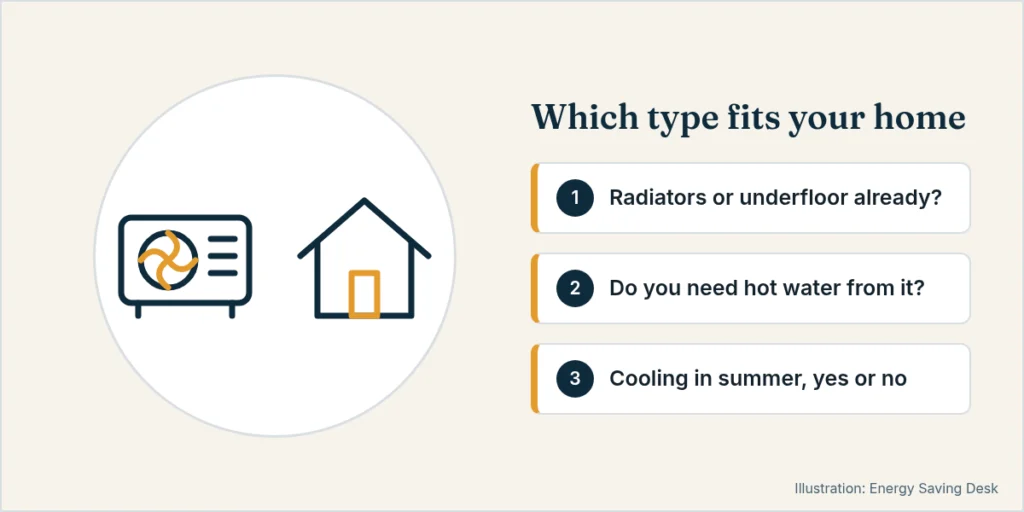
- What heats your hot water today? Air-to-air won’t. Price in a solution.
- Do you want cooling? Summer heat is now a real factor in UK homes and an obvious one in the US and Australia.
- How many rooms need heat? Every room means more indoor units, which hurts the case for air-to-air.
- What does your heat loss survey say? Both systems need correct sizing. Oversized heat pumps cycle on and off and lose efficiency.
Running costs
The efficiency principles are the same for both: the smaller the temperature lift, the higher the efficiency. Air-to-water systems are most efficient at low flow temperatures. Air-to-air systems deliver heat to air at around 30–45 °C, which can help their efficiency, but the real-world figure depends on the product and the house. For a full cost comparison with gas, see heat pump running costs vs gas. To see what a given efficiency means for your bills compared with gas or oil, use our heat pump vs gas calculator.
Worked example: heating one living area with air-to-air
Assumptions, all illustrative: the living area needs 4,000 kWh of heat a year (a heat loss survey gives your real figure), with Ofgem’s October–December 2026 capped prices and a 90% efficient gas boiler as the comparison.
- Gas: 4,000 ÷ 0.9 × 7.97p ≈ £354 a year
- Air-to-air at SCOP 3.5: 1,143 kWh × 26.32p ≈ £301
- Air-to-air at SCOP 4.5 (an assumed figure for an efficient unit): 889 kWh ≈ £234
That’s a saving of roughly £50–£120 a year on that zone: useful, but modest. The case for air-to-air usually rests on cooling, a lower installation cost and the £2,500 grant, not on heating savings alone. If you keep a gas boiler for hot water, you also keep the gas standing charge (about £108 a year at current rates). Check the grant rules too: BUS is for replacing a fossil-fuel heating system.
Honest drawbacks of each
Air-to-water: it needs space for a hot water cylinder, possibly bigger radiators, and costs more upfront even after the larger grant. It also warms rooms more slowly than blown air.
Air-to-air: it doesn’t heat water, the indoor units are visible and make some fan noise, and warm moving air feels different from a radiator. Every extra room needs another unit, filters need regular cleaning, and refrigerant lines have to run through walls.
Neither suits flats where the freeholder won’t allow an outdoor unit, or very leaky homes that haven’t fixed the basics first. Start with draught-proofing and loft insulation, then size the heat pump to the improved house.
Questions to ask an air-to-air installer
- What heating efficiency (SCOP) does this unit have, and for which climate zone? Ratings differ for warmer and colder climates.
- Where will the indoor unit go, and will its airflow reach the rooms next to it? One unit in a hallway rarely heats bedrooms properly behind closed doors.
- Where does the condensate drain go? In heating mode the outdoor unit also produces water during defrost cycles.
- How loud are the indoor and outdoor units, and where will the outdoor unit sit relative to bedrooms, both yours and your neighbours’?
- What maintenance is needed, and how often should the filters be cleaned?
Related
More guides in Heating & Cooling.
Sources
- Ofgem, Boiler Upgrade Scheme (grant amounts including air-to-air): https://www.ofgem.gov.uk/environmental-and-social-schemes/boiler-upgrade-scheme-bus
- GOV.UK, apply for the Boiler Upgrade Scheme: https://www.gov.uk/apply-boiler-upgrade-scheme
- Energy Saving Trust, air source heat pumps: https://energysavingtrust.org.uk/advice/air-source-heat-pumps/
- U.S. DOE, heat pumps: https://www.energy.gov/heat-pumps