Australia’s Cheaper Home Batteries Program Explained (2026)
Last checked: October 29, 2026. Reviewed and expanded on October 31, 2026. Checked against the DCCEEW program page (updated June 9, 2026).
The federal Cheaper Home Batteries Program takes about 30% off the cost of a home battery connected to solar. You don’t apply or wait for a rebate cheque. The discount comes off your installer’s price upfront. The catch is that the discount shrinks every six months, and since May 2026 it shrinks faster for big batteries.
How it works
The discount runs through the existing Small-scale Renewable Energy Scheme (SRES). When an eligible battery is installed, it creates small-scale technology certificates (STCs). Your installer usually takes those certificates and gives you the value as a discount. You can also claim them yourself through the Clean Energy Regulator’s REC Registry, but few households do.
To qualify:
- The battery must be connected to new or existing rooftop solar.
- Usable capacity between 5 and 100 kWh.
- The battery must be on the Clean Energy Council’s approved product list.
- It must be installed by a Solar Accreditation Australia (SAA) accredited installer.
- It must be capable of joining a virtual power plant (VPP), though you don’t have to sign up to one.
It applies to homes, small businesses and community facilities, and stacks with some state programs.
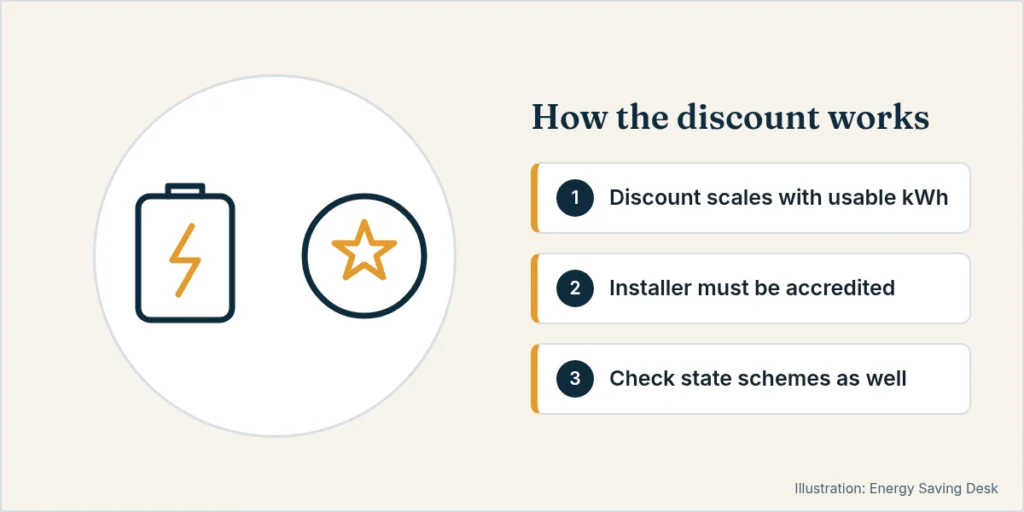
The two dials that set your discount
1. The STC factor (per kWh), which steps down every six months:
| Installed | STCs per usable kWh |
|---|---|
| May–Dec 2026 | 6.8 |
| Jan–Jun 2027 | 5.7 |
| Jul–Dec 2027 | 5.2 |
| 2028 | 4.6 then 4.1 |
| 2029 | 3.6 then 3.1 |
| 2030 | 2.6 then 2.1 |
2. The capacity taper, in effect since May 1, 2026:
| Part of the battery’s usable capacity | Share that earns STCs |
|---|---|
| 0–14 kWh | 100% |
| 14–28 kWh | 60% |
| 28–50 kWh | 15% |
A worked example (estimate)
The value of an STC is set by the market, not the government. The legal cap is $40, and in practice installers pass on a bit less. Assuming about $37 per STC (an assumption, not an official figure), a battery installed before the end of 2026 earns:
- 10 kWh usable: 10 × 6.8 = 68 STCs ≈ $2,500 off
- 20 kWh usable: (14 × 6.8) + (6 × 6.8 × 0.6) = 95.2 + 24.5 = about 119 STCs ≈ $4,400 off
The same 10 kWh battery installed in early 2027 earns 57 STCs, about $2,100. That’s a few hundred dollars less for waiting a couple of months.
Is it worth adding a battery now?
It depends on what you export. If your solar sends most of its daytime output to the grid for a few cents per kWh and you buy evening power at 30c or more, a battery sized to your evening use usually makes sense with the discount. Our solar payback guide uses the same logic. A 20 kWh+ battery is harder to justify since the taper, unless you have a big evening load such as an EV or a heat pump. You can try your own export and evening rates in our home battery payback calculator.
Worked example: does the discount make a battery pay?
All rates here are illustrative, so use the ones on your bill. Say your feed-in tariff is 5c/kWh, you pay 30c/kWh in the evening, and a 10 kWh battery moves 8 kWh a day of solar that would otherwise be exported:
- Value: 8 × (30c − 5c) = $2.00 a day, or about $730 a year.
- After roughly 10% battery losses: about $660 a year.
- For a 10-year payback, your net price after the discount needs to be about $6,600 or less. With about $2,500 off, that’s an installed price of roughly $9,100 before the discount.
Two cautions. Eight kWh a day is a sunny-season figure, and in winter there’s less surplus to store, so the year-round average is usually lower. And the gap between your import and export rates matters most. If your evening rate is 40c, the same battery earns about 40% more.
Who it’s not for
- Homes without rooftop solar. They aren’t eligible.
- Households that already use most of their solar during the day. There’s little surplus to store.
- Anyone considering more than about 14 kWh without a big evening load. The taper cuts the discount on every kWh above 14.
- Renters. The property owner has to agree to, and usually pay for, the installation.
Honest drawbacks: STC prices move with the market, so your discount isn’t fixed. The discount is only as good as what your installer passes on, so ask to see it as a line item. VPP-capable batteries rely on an internet connection and the maker’s platform.
How to check a battery quote
- Usable capacity, not nominal. The discount is calculated on usable kWh, and so should your price comparison be.
- The number of STCs. It should be roughly usable kWh × the current factor, with the taper applied above 14 kWh. If it doesn’t add up, ask why.
- The STC price used. Ask what dollar value per certificate the installer has applied.
- Price per usable kWh after the discount. This is the fairest way to compare quotes for batteries of different sizes.
- VPP terms, if offered. Check how much control you hand over, how much battery capacity is reserved for you, and how you can leave.
FAQ
Do I need to apply?
No. Your installer applies the discount. Ask to see it as a separate line on the quote.
Can I get it for a battery without solar?
No. The battery must be connected to rooftop solar, new or existing.
Do I have to join a VPP?
No. The battery has to be VPP-capable, but joining is your choice.
Can I combine it with state rebates?
In some states, yes. Check your state energy department’s page. Rules differ.
Related
- Best home batteries for solar in the UK (useful sizing logic)
- Is solar still worth it?
More guides in Grants, Rebates & Incentives.
Sources
- DCCEEW, Cheaper Home Batteries Program (eligibility, STC factor, taper): https://www.dcceew.gov.au/energy/programs/cheaper-home-batteries
- Clean Energy Regulator, small-scale technology certificates: https://cer.gov.au/schemes/renewable-energy-target/small-scale-renewable-energy-scheme