Home EV Charger Buying Guide (US and UK, 2026)
Last checked: November 10, 2026.
For most EV owners, the “best” home charger is the one that fits your electrical supply, your car and your tariff. A bigger charger isn’t automatically better. It needs a bigger circuit, may need a panel upgrade, and doesn’t help if your car can’t accept that much AC power or you only drive 30 miles a day.
United States: Level 2 basics
A Level 2 charger runs on 240 V. The key number is its current in amps, and the circuit has to be sized for it. Under the National Electrical Code (Article 625), EV charging counts as a continuous load, so the circuit must be rated at 125% of the charger’s current:
| Charger setting | Breaker needed | Approx. power at 240 V |
|---|---|---|
| 32 A | 40 A | 7.7 kW |
| 40 A | 50 A | 9.6 kW |
| 48 A (hardwired) | 60 A | 11.5 kW |
At around 3–4 miles per kWh, a 7.7 kW charger adds very roughly 25–30 miles of range per hour of charging. That’s enough to refill most daily driving overnight. Choose 48 A only if your car’s onboard charger can use it and your panel has the capacity.
Plug-in or hardwired? A plug-in charger on a NEMA 14-50 outlet is easy to replace. Hardwiring allows 48 A and is often recommended for outdoor installs. Either way, a licensed electrician should do a load calculation and pull a permit where required.
Tax credit: the federal 30C credit for home charging equipment is no longer available for property placed in service after June 30, 2026. Many utilities still offer rebates or special EV rates. Check your utility’s website.
United Kingdom: what’s different
- Smart charging is mandatory. Under the Electric Vehicles (Smart Charge Points) Regulations 2021, chargers sold for home use in Great Britain must be smart: able to schedule charging and respond to grid signals, and set by default to avoid peak hours. They must also meet security requirements.
- On a single-phase supply, home chargers are typically up to 7 kW. 22 kW needs a three-phase supply, which many UK homes don’t have.
- Grant for renters and flat owners: the OZEV EV chargepoint grant covers 75% of costs, up to £500 per socket from 1 April 2026 (previously £350). It’s only for renters and flat owners with dedicated private off-street parking. Apply through OZEV and wait for confirmation before installing. The scheme currently runs to March 31, 2027. There is no general grant for homeowners in houses.
- Your tariff matters more than the charger. EV tariffs with cheap overnight rates can cut charging costs to a fraction of the standard capped rate. Make sure the charger works with your intended tariff.
Worked example: 30 miles a day
30 miles a day is about 10,950 miles a year. At 3.5 miles per kWh, the middle of the range above, the car needs about 3,130 kWh. Allowing an assumed 10% for charging losses, that’s about 3,440 kWh from the wall.
- UK, standard capped rate (26.32p): about £905 a year. On an EV tariff whose overnight rate is a quarter of that, about £226.
- US average (18.16¢, EIA, August 2026): about $625 a year.
Charging time per night: about 9.4 kWh from the wall. A 7.7 kW charger does that in about 1.2 hours. A US Level 1 outlet at 12 A × 120 V ≈ 1.4 kW takes about 6.5 hours, which still fits overnight. For this mileage, a big charger buys convenience and margin, not a lower bill. The tariff is what cuts the cost.
To try your own mileage and tariff, enter the charger’s power, the hours you charge and your price per kWh into our appliance running cost calculator.
Who doesn’t need a dedicated charger (yet)
- Low-mileage US drivers with an outlet in the garage who can plug in every night. Level 1 may be enough. Check the outlet and circuit with an electrician.
- Homes without off-street parking. A home charger usually isn’t an option.
- Renters without the landlord’s permission. In the UK, look at the OZEV grant above once you have permission.
Honest drawbacks: the electrical work, especially a panel or fuse upgrade, can cost more than the charger. Smart features depend on the maker’s app and cloud. And tethered cables wear out and can be a trip hazard on shared driveways.
Features worth paying for
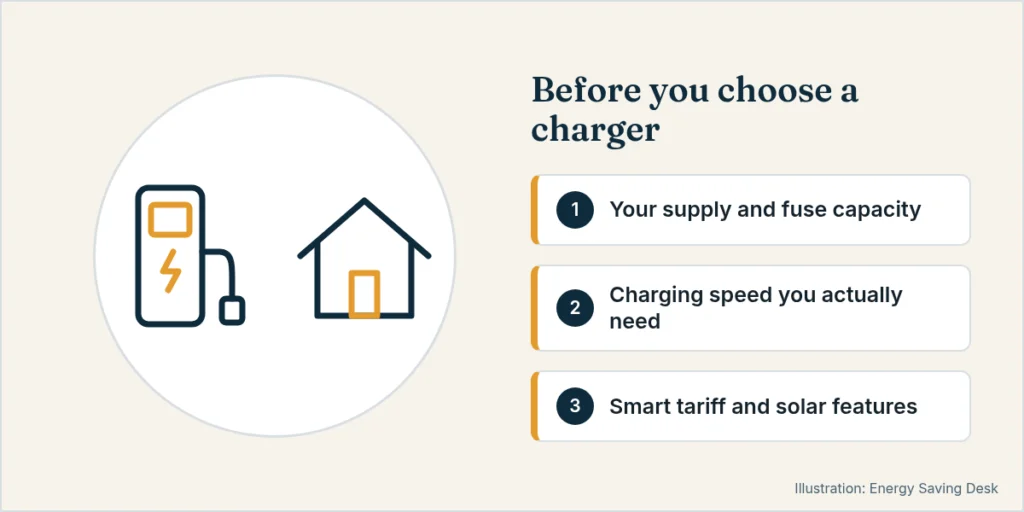
- Load management, so the charger slows down when the house is drawing a lot. This can avoid a panel or fuse upgrade.
- Solar diversion, if you have panels, to charge from surplus solar.
- Tariff integration and a decent app.
- Tethered vs untethered: a fixed cable is convenient, while a socket is tidier and suits future cars with different plugs.
- Weather rating suitable for outdoor use, and a long warranty.
FAQ
Can I just use a regular outlet?
Level 1 (120 V in the US, a 3-pin plug in the UK) works for low mileage but is slow. In the UK, manufacturers usually advise against regular overnight use on a standard socket.
Do I need a panel upgrade?
Not always. Load management or a smaller charger often avoids one. Ask your electrician for a load calculation.
Can a home battery charge my EV?
Yes, but a typical home battery holds only a fraction of an EV battery. Batteries help most with timing, not volume. See home batteries for solar.
Related
More guides in EV Charging.
Sources
- IRS, Alternative Fuel Vehicle Refueling Property Credit for Individuals and Instructions for Form 8911 (credit ends for property placed in service after June 30, 2026): https://www.irs.gov/credits-deductions/alternative-fuel-vehicle-refueling-property-credit-for-individuals and https://www.irs.gov/instructions/i8911
- UK EV chargepoint grant for renters and flat owners: https://www.gov.uk/electric-vehicle-chargepoint-grant-household
- GOV.UK, changes to EV chargepoint grants from 1 April 2026: https://www.gov.uk/guidance/changes-to-electric-vehicle-chargepoint-grant-schemes-from-1-april-2026
- UK residential chargepoints, minimum technical specification: https://www.gov.uk/guidance/residential-chargepoints-minimum-technical-specification
- Electric Vehicles (Smart Charge Points) Regulations 2021: https://www.legislation.gov.uk/uksi/2021/1467/contents/made
- U.S. DOE Alternative Fuels Data Center, charging at home (Level 2 at 240 V; EV charging is a continuous load under NEC Article 625): https://afdc.energy.gov/fuels/electricity-charging-home
- U.S. DOE, Electric Vehicle Charging for Multifamily Housing (NEC requires wiring and overcurrent protection at 125% of the charger’s nameplate continuous output): https://www.energy.gov/documents/multifamily-ev-charging-guide
- GOV.UK, regulations: electric vehicle smart charge points (Great Britain; default off-peak hours, smart functionality, security): https://www.gov.uk/guidance/regulations-electric-vehicle-smart-charge-points
- GOV.UK Find a Grant, EV chargepoint grant for renters and flat owners (must not install before OZEV confirms eligibility; funding to 31 March 2027): https://www.find-government-grants.service.gov.uk/grants/electric-vehicle-chargepoint-grant-for-renters-and-flat-owners-1
- U.S. EIA, Electric Power Monthly, Table 5.3 (U.S. average residential price 18.16¢/kWh, August 2026; released October 23, 2026; next release November 24, 2026): https://www.eia.gov/electricity/monthly/epm_table_grapher.php?t=table_5_03