Is Solar Still Worth It in 2026 Without the Federal Tax Credit?
Last checked: October 29, 2026. This is general information, not financial or tax advice.
For more than a decade, the 30% federal tax credit for home solar did a lot of the selling. It is now gone for homeowners who buy a system: under the 2025 budget law (Public Law 119-21), the Residential Clean Energy Credit (Section 25D) does not apply to spending after December 31, 2025, according to the IRS.
So the question is fair: does solar still pay for itself? For many homes it does, but more slowly, and the answer now depends more on your electricity rate and on how your utility credits the power you send back to the grid.
What changed, in numbers
- The credit. A 30% credit cut the cost of a $30,000 system to $21,000. Without it, simple payback takes 1 ÷ 0.7 ≈ 1.43 times as long. A system that used to pay back in 7 years now takes about 10, all else being equal.
- Prices. EnergySage’s marketplace report for the first half of 2026 put the median quoted price at $2.57 per watt before incentives, up about 3% on late 2025. Solar-only quotes were flat at $2.62/W. At the median system size of about 12 kW, that is roughly $30,700.
- Payback. The same report put the average estimated payback at 10.9 years, up from 10.1. EnergySage notes that part of the increase comes from a change in its own method.
Panels typically come with 25-year performance warranties, so a 10–12 year payback can still leave a long period of savings. That only holds if the system is installed well and your rate assumptions hold.
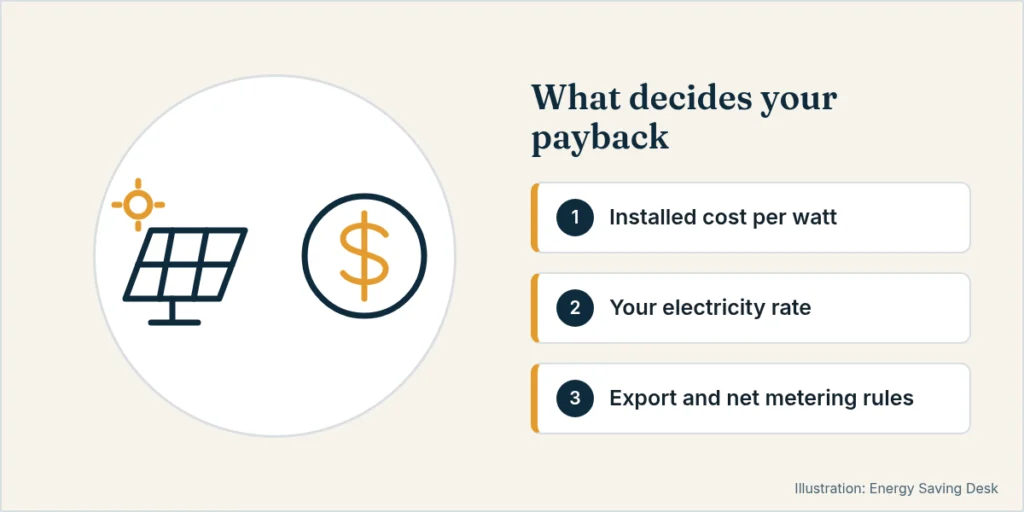
The three things that decide your payback now
1. Your electricity rate
The more you pay per kWh, the more each kWh from your roof is worth. EnergySage notes average residential rates above 29 cents per kWh in Massachusetts and New York and about 35 cents in California. In states with rates in the low teens, the maths is much harder without the credit.
2. How exports are credited
With full retail net metering, a kWh you export is worth the same as one you buy. Many utilities have moved to net billing, where exports earn less. California’s NEM 3.0 is the best-known example. Under those rules, using your solar yourself (running the dishwasher at midday, charging an EV during the day, or adding a battery) is worth much more than exporting it.
3. Your roof and your sun
Orientation, shading and location change output a lot. NREL’s free PVWatts calculator (pvwatts.nrel.gov) estimates annual production for your address. Use it rather than an installer’s rough average.
A worked example you can redo with your own numbers
Assumptions (illustrative, not a quote):
- 8 kW system at $2.62/W = $20,960
- Production: 1,300 kWh per kW per year (check yours in PVWatts) = 10,400 kWh a year
- Electricity rate: $0.18/kWh
| Scenario | Value of solar per year | Simple payback |
|---|---|---|
| Full retail net metering | 10,400 × $0.18 = $1,872 | about 11.2 years |
| Net billing, exports at ~half value, 50% self-use | about $1,404 | about 14.9 years |
| Same as above, but at $0.30/kWh | about $2,340 | about 9.0 years |
Simple payback ignores rising electricity prices, which would shorten it, and panel degradation and maintenance, which lengthen it. A sensible next step is to get two or three quotes and run each through the same assumptions. Our solar panel payback calculator applies the same simple-payback method, so you can run each quote through it.
Ways people are still making the numbers work
- Leases and power purchase agreements (PPAs). Here the installer or a finance company owns the system, and you pay for the power or a fixed monthly fee. EnergySage reports that the share of installers offering these rose from 14% to 41% in six months. Read the contract carefully: check the escalator clause, what happens if you sell the house, and who maintains the system.
- State and utility incentives. Some states and utilities still offer rebates, performance payments or property-tax exemptions. DSIRE (dsireusa.org) lists them by state.
- Smaller, self-consumption-focused systems. Sizing to your daytime use rather than your annual total can improve the return where exports are poorly paid.
- Batteries. A battery adds cost but can raise the value of each solar kWh under time-of-use rates or poor export credits, and it gives backup in outages. We cover this in a separate guide.
When solar probably isn’t worth it right now
- Your rate is low (around 12–14 cents or less) and your utility pays little for exports.
- Your roof needs replacing within a few years. Do the roof first.
- Heavy shading that can’t be fixed.
- You expect to move soon and the system would be financed with a loan that has to be cleared at sale.
Bottom line
Losing the 30% credit made home solar about 40% slower to pay back, but not pointless. If you pay high rates, have a good roof, and either keep net metering or can use most of what you generate, a purchased system can still pay for itself in roughly 9–12 years. If not, look at a lease or PPA with care, or wait.
Related guides
- Plug-in and balcony solar rules (US and UK)
- Best home batteries for solar in the UK
- Australia’s Cheaper Home Batteries Program
More guides in Solar & Home Batteries.
Sources
- IRS, FAQs on changes to 25C, 25D and other credits under P.L. 119-21: https://www.irs.gov/newsroom/faqs-for-modification-of-sections-25c-25d-25e-30c-30d-45l-45w-and-179d-under-public-law-119-21-139-stat-72-july-4-2025-commonly-known-as-the-one-big-beautiful-bill-obbb
- IRS, Residential Clean Energy Credit: https://www.irs.gov/credits-deductions/residential-clean-energy-credit
- EnergySage, H1 2026 market highlights: https://www.energysage.com/news/home-energy-market-h1-2026-highlights/
- pv magazine, residential solar prices H1 2026: https://www.pv-magazine.com/2026/10/24/residential-solar-prices-rise-3-2-as-third-party-ownership-gains-ground/
- NREL PVWatts calculator: https://pvwatts.nrel.gov/
- DSIRE incentive database: https://www.dsireusa.org/