
Boiler Upgrade Scheme 2026: Who Qualifies for £7,500
Last checked: October 29, 2026. Reviewed and expanded on October 31, 2026. Checked against GOV.UK and Ofgem. Grant amounts and rules can change, so confirm with your installer before you sign anything.
The Boiler Upgrade Scheme (BUS) is the main government grant for replacing a fossil-fuel heating system with a heat pump in England and Wales. It takes £7,500 off the price of an air source or ground source heat pump, and the installer handles the application. Here is who can get it, what it covers and how the process works.
How much you can get
One grant per property:
| System | Grant |
|---|---|
| Air source heat pump (air-to-water) | £7,500 |
| Ground source heat pump (incl. water source and shared ground loops) | £7,500 |
| Air-to-air heat pump | £2,500 |
| Biomass boiler (rural, off-gas-grid only) | £5,000 |
Extra £1,500 until March 2027: if your home is heated by oil or LPG and has no mains gas connection, you can get an additional £1,500 towards an air source or ground source heat pump. That makes £9,000 in total.
Hybrid systems, such as a gas boiler paired with a heat pump, are not eligible. Neither is replacing an existing low-carbon heating system.
Who qualifies
You’re eligible if both of these are true:
- You own the property. This includes your home, a second home, a business property, or a property you rent out to tenants.
- You’re replacing a fossil-fuel heating system, such as gas, oil, LPG or direct electric heating.
Having already had help with insulation or other efficiency work does not disqualify you.
Properties that don’t qualify
- Most new builds still being built by a developer. If you move into a finished new build that has a fossil-fuel boiler, you may be able to apply.
- Social housing.
- Properties that have already had government funding for a heat pump or biomass boiler.
Self-builds can qualify if you or the original owner built it (or paid a builder to) and it has never been owned by a business.
Where it applies
England and Wales only. Scotland has its own grants and interest-free loans through Home Energy Scotland. Northern Ireland’s Boiler Replacement Scheme is closed.
How the process works
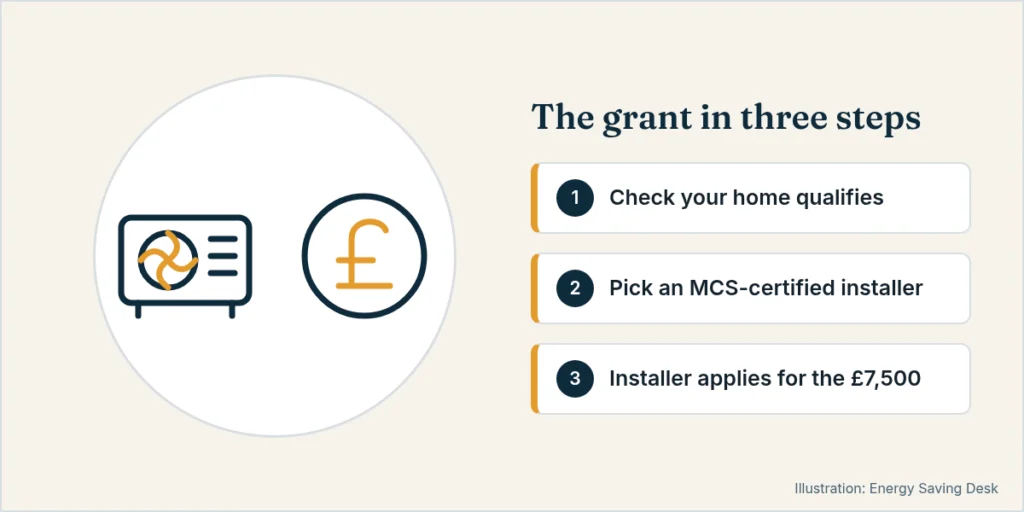
- Get quotes from MCS-certified installers. Only MCS-certified installers can apply for the grant. Get at least two or three quotes. Each should include a heat loss calculation for your home, not just a unit size.
- The installer confirms you’re eligible.
- Agree a quote. The grant is deducted from the price and shown on the quote and the invoice.
- The installer applies to Ofgem on your behalf. Ofgem will contact you to confirm the installer is acting for you, and may phone or visit to check the installation. MCS may also run its own checks.
- Installation and commissioning must happen within 120 days of the application, or the grant is not paid.
What a heat pump costs after the grant
Installed prices vary widely with the size of the home, the heat loss and whether radiators or pipework need upgrading. Industry guides put typical air source installations at roughly £9,000–£14,000 before the grant, but treat that as a broad range. Your quotes are what count. The real question is how the running cost compares with what you pay now, which depends on your tariff and on how well the system is designed and set up. We cover running costs in a separate guide. Our heat pump vs gas calculator estimates that comparison, and the payback after the grant.
Worked example: what you might actually pay
The Energy Saving Trust puts a typical air source heat pump installation at around £12,000. Your quotes may be well above or below that. Using that figure:
- Gas-heated home: £12,000 − £7,500 = about £4,500.
- Oil- or LPG-heated home with no mains gas, before March 2027: £12,000 − £9,000 = about £3,000.
- Air-to-air system: the grant is £2,500, and it doesn’t heat your hot water, so budget for a separate solution.
Compare that net price with what you would spend anyway, not with zero. If your boiler is near the end of its life, you’ll pay for a replacement either way, so the real extra cost of going heat pump is the difference between the two quotes.
Running costs are a separate question. At this winter’s capped prices, a heat pump needs a seasonal efficiency of about 3 just to match a 90% gas boiler on a standard tariff (see our running cost guide). The grant fixes the upfront maths. The design of the system and your tariff decide whether it saves money every year.
Honest drawbacks, and who it may not suit
- Space. Air-to-water systems usually need a hot water cylinder. If you have a combi boiler and no cupboard to spare, that’s a real obstacle.
- Radiators. Running at low flow temperatures often means some larger radiators, which adds cost and disruption.
- Tenants can’t apply. The grant goes to the property owner. Landlords can apply for rented homes.
- The 120-day deadline. If the installation slips past 120 days from the application, the grant isn’t paid. Ask installers about their lead times before you agree.
- The off-gas £1,500 top-up is temporary and currently ends in March 2027.
- Scotland and Northern Ireland aren’t covered. See the section above.
Tips before you sign
- Ask how the system was sized. A proper room-by-room heat loss calculation is the foundation of a system that runs efficiently.
- Ask about flow temperature. Heat pumps are most efficient at low flow temperatures, which may mean some larger radiators.
- Ask what’s included: hot water cylinder, controls, any electrical work, removal of the old boiler, and aftercare.
- Look at heat pump tariffs. Several UK suppliers offer cheaper overnight or smart tariffs that suit heat pumps.
- Don’t pay a deposit for “grant processing”. The installer applies, and the grant is simply deducted from the price.
Related guides
- Heat pump running costs vs a gas boiler
- Air-to-air vs air-to-water heat pumps
- Loft insulation cost and savings
More guides in Grants, Rebates & Incentives.
Sources
- GOV.UK, Apply for the Boiler Upgrade Scheme (overview): https://www.gov.uk/apply-boiler-upgrade-scheme
- GOV.UK, What you can get: https://www.gov.uk/apply-boiler-upgrade-scheme/what-you-can-get
- GOV.UK, Check if you’re eligible: https://www.gov.uk/apply-boiler-upgrade-scheme/check-if-youre-eligible
- GOV.UK, How to apply: https://www.gov.uk/apply-boiler-upgrade-scheme/how-to-apply
- Ofgem, BUS guidance for property owners: https://www.ofgem.gov.uk/environmental-and-social-schemes/boiler-upgrade-scheme-bus/property-owners
- Homebuilding & Renovating, renewables cost guide (price range): https://www.homebuilding.co.uk/eco-homes/energy/renewables-costs
- Energy Saving Trust, air source heat pumps (typical installation around £12,000): https://energysavingtrust.org.uk/advice/air-source-heat-pumps/