Portable Power Station vs Generator for Home Backup
Last checked: October 29, 2026. Reviewed and expanded on October 31, 2026.
A fuel generator makes electricity for as long as you keep feeding it. A power station stores a fixed amount and runs silently indoors until it’s empty. That one difference drives almost everything else in this comparison. To compare runtime and cost per kWh for your own loads, try our power station calculator.
The core trade-off
| Portable power station | Portable fuel generator | |
|---|---|---|
| Energy available | Fixed (e.g. 1–4 kWh per unit) until recharged | As long as you have fuel |
| Where it can run | Indoors | Outdoors only, well away from the house |
| Noise | Near silent (fans only) | Loud, though inverter generators are quieter |
| Fumes | None | Carbon monoxide and exhaust |
| Maintenance | Top up the charge every few months | Oil changes, fuel stabilizer, running it regularly |
| Running cost | Electricity or solar to recharge | Fuel |
| Best at | Short outages, sensitive electronics, apartments | Long outages, heavy loads |
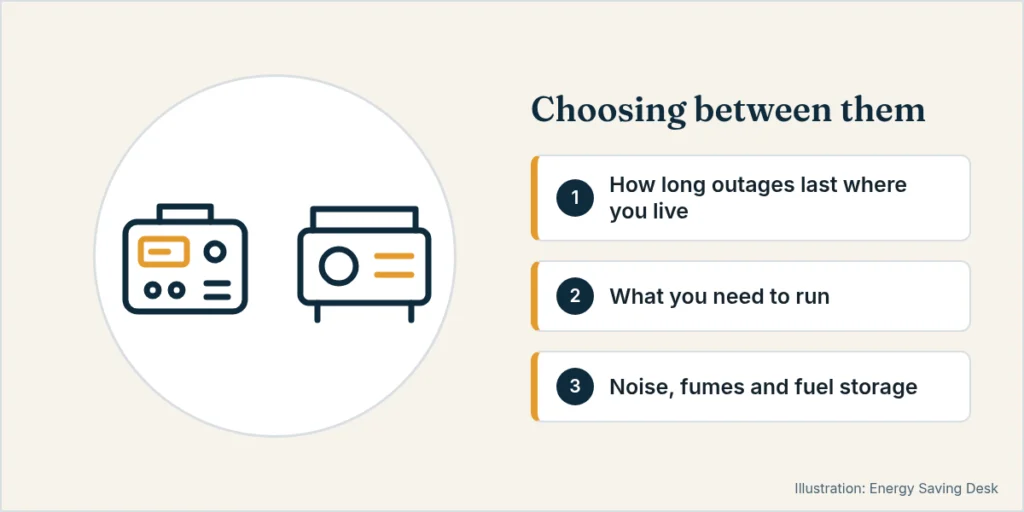
Safety comes first with generators
The U.S. Consumer Product Safety Commission is blunt about this: use a portable generator only outdoors, at least 20 feet from the house, with the exhaust pointed away from windows, doors and vents. Never run it in a garage, basement, shed, porch or carport, even with the doors open. Carbon monoxide has no smell and can kill in minutes. Fit CO alarms on every level of the home. People die every year from generators run too close to the house.
A power station has no exhaust, so it can sit next to the fridge or the bed. That alone settles the question for a lot of apartment dwellers.
Whichever you choose, never back-feed your home by plugging into a wall socket. Use extension leads to appliances, or have an electrician install an inlet and transfer switch.
When a power station is the better choice
- Outages in your area are usually a few hours.
- You live in an apartment or have nowhere safe to run a generator.
- You mainly need the fridge, the internet, lights, phones and medical devices like a CPAP (see our CPAP sizing guide).
- You don’t want to store fuel.
- You want it to double as a camping or garden power source.
When a generator makes more sense
- You regularly lose power for a day or more (storms, rural lines).
- You need to run big loads: a well pump, a sump pump through a long storm, electric heating, or central AC.
- You already maintain small engines and are comfortable storing fuel safely.
The hybrid approach
Many households combine the two. A power station covers the first hours silently and indoors. If the outage drags on, the generator runs outside for a couple of hours to refill the station and run heavy loads, then gets switched off. Some power station makers sell generators that start automatically when the battery runs low (EcoFlow mentions this for its DELTA 3 series with its Smart Generator). Solar panels can do the same job more quietly on sunny days.
Worked example: a three-day outage
Essentials only. An average US fridge-freezer uses about 1.6 kWh a day (DOE figure, see our fridge guide). We assume about 0.4 kWh a day for the router, phone charging and LED lights. That’s about 2 kWh a day, or 6 kWh over three days.
- 1 kWh power station (about 820 Wh usable): around 10 hours.
- 2 kWh power station (about 1,630 Wh usable): around 20 hours, and less once the inverter’s idle draw is counted.
- Batteries alone for three days: about 7.5 kWh of rated capacity (6 ÷ 0.8), which means a large expandable system.
- Solar top-up: 400 W of panels at an assumed 70% for about 5 good hours gives roughly 1.4 kWh a day. With a 2 kWh station, that roughly keeps the fridge going in summer. In a winter storm it gives far less.
Refilling a 1 kWh station from the grid afterwards costs about 20¢ at the U.S. average of 18.16¢/kWh (EIA, August 2026). The battery’s energy is cheap. What you pay for is the battery itself.
Honest drawbacks of each
Power station: a high price per kWh stored, a fixed amount of energy, a lot of weight per kWh, power lost to the inverter whenever it’s on, and it can’t run central AC or electric heating for long.
Generator: carbon monoxide risk, noise for you and your neighbours, and fuel that has to be stored safely and rotated. It needs regular test runs, and it sits outdoors where it can be stolen. In a widespread outage, filling stations may also be shut or queued, so count on the fuel you already have.
Neither suits whole-home backup. For that, look at a standby generator or a home battery, installed with a transfer switch by an electrician.
Rough cost thinking
We won’t quote prices here because they move quickly. Here is how to compare:
- A power station’s cost per kWh stored is high, but its running cost is close to zero.
- A generator is cheaper per watt of output, but you pay for fuel, oil and upkeep, and it has to run regularly to stay reliable.
- For a once-a-year three-hour outage, a mid-size power station is usually the simpler, safer buy. For frequent multi-day outages, a generator (or a home battery with solar) usually wins.
Related guides
- Best portable power stations for home backup
- How long a power station runs a fridge
- EcoFlow DELTA 3 Plus vs Anker SOLIX C1000 Gen 2
More guides in Power Stations & Portable Power.
Sources
- CPSC, Generators and carbon monoxide (safety guide): https://www.cpsc.gov/Safety-Education/Safety-Guides/Carbon-Monoxide-Home/Generators-and-Engine-Driven-Tools
- CPSC, Carbon Monoxide Information Center: https://www.cpsc.gov/Safety-Education/Safety-Education-Centers/Carbon-Monoxide-Information-Center
- EcoFlow DELTA 3 series (Smart Generator integration): https://www.ecoflow.com/us/delta-3-series-portable-power-station
- U.S. EIA, Electric Power Monthly, Table 5.3 (U.S. average residential price 18.16¢/kWh, August 2026; released October 23, 2026): https://www.eia.gov/electricity/monthly/epm_table_grapher.php?t=table_5_03