How Many Solar Panels Do I Need? Sizing With Worked Examples
Last checked: November 13, 2026. Solar yields are our own runs of the EU’s free PVGIS tool (first run November 1, spot-checked November 13, 2026). Usage figures come from Ofgem, the U.S. EIA and Milieu Centraal. We don’t sell or install panels, and we don’t earn anything from the links in this guide (affiliate disclosure).
“How many panels?” has three honest answers, depending on what you want the panels to do. You can size them to cover your whole year’s use, to cover only what you use while the sun is up, or to fill the roof for a future EV or heat pump. Which one is right depends mostly on what your electricity company pays for the power you export.
This guide gives you the formula, a yield table for eight cities, and worked examples for typical homes in Great Britain, the Netherlands and two very different US cities.
The formula
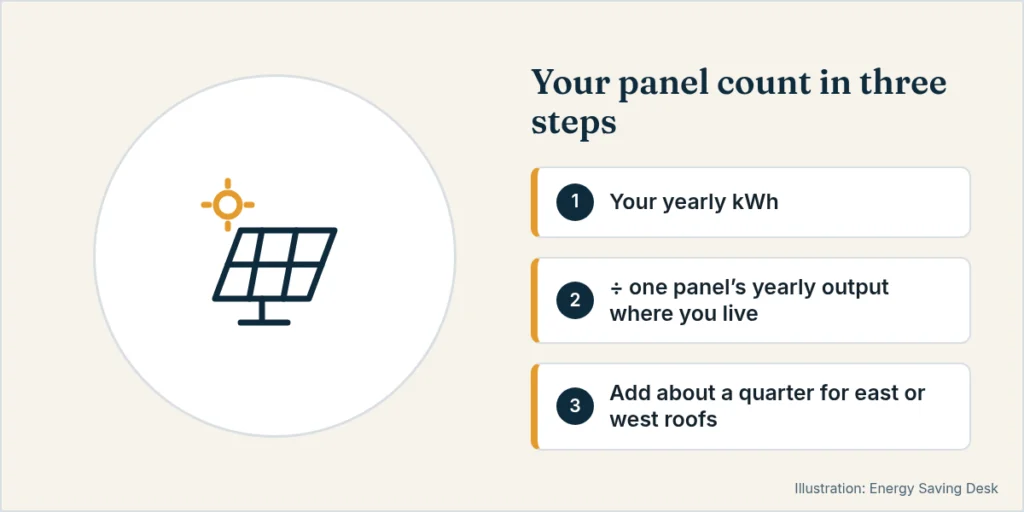
Panels needed = yearly kWh you want to cover ÷ (local yield per kWp × panel size in kWp)
- Yearly kWh: take it from your bills or smart-meter app. Use the last 12 months, not one quarter.
- Local yield: how many kWh one kilowatt-peak (kWp) of panels makes per year where you live. It depends on sunshine, tilt and which way the roof faces.
- Panel size: most new home panels are around 430–460 W. We use 455 W (0.455 kWp), the size Octopus Energy fits in its UK packages.
One 455 W panel, the AIKO A-MAH54Db for example, measures 1,722 × 1,134 mm (about 1.95 m²) and weighs 24 kg, according to AIKO’s datasheet. Budget roughly 2 m² of roof per panel, plus the edge gaps your installer needs.
How much one panel makes where you live
We ran PVGIS 5.3, the European Commission’s free solar tool, for a 1 kWp system with 14% system losses at the best fixed tilt, facing the equator. European cities use PVGIS’s satellite data (SARAH3). The US, Canadian and Australian cities use its ERA5 data, which is coarser, so cross-check those with your installer’s figures.
| City | Yield per kWp per year | One 455 W panel per year | Panel in its worst month | Panel in its best month | Panels per 1,000 kWh a year |
|---|---|---|---|---|---|
| London, UK | 1,023 kWh | 465 kWh | 17 kWh | 55 kWh | 2.1 |
| Amsterdam, NL | 1,027 kWh | 467 kWh | 13 kWh | 59 kWh | 2.1 |
| Munich, DE | 1,139 kWh | 518 kWh | 22 kWh | 58 kWh | 1.9 |
| Madrid, ES | 1,621 kWh | 737 kWh | 46 kWh | 76 kWh | 1.4 |
| Toronto, CA | 1,307 kWh | 595 kWh | 25 kWh | 67 kWh | 1.7 |
| Boston, US | 1,392 kWh | 633 kWh | 39 kWh | 62 kWh | 1.6 |
| Phoenix, US | 1,831 kWh | 833 kWh | 59 kWh | 79 kWh | 1.2 |
| Sydney, AU (30° tilt, north-facing) | 1,557 kWh | 708 kWh | 43 kWh | 68 kWh | 1.4 |
Two things stand out. Northern Europe gets about the same yearly yield as each other, but the worst winter month gives only about a fifth to two-fifths of the best summer month. And a panel in Phoenix makes nearly twice what the same panel makes in London.
Your roof’s direction changes the count
We reran PVGIS for London with different roof directions:
- South-facing, 35° tilt: 1,019 kWh/kWp
- South-facing, 15° tilt: 951 kWh/kWp (about 93%)
- Flat-mounted: 845 kWh/kWp (about 83%)
- East-facing, 35°: 818 kWh/kWp (about 80%)
- West-facing, 35°: 787 kWh/kWp (about 77%)
So an east or west roof needs roughly a quarter more panels for the same yearly output. The upside is that east-west arrays spread generation over the morning and evening, when you’re more likely to be home to use it.
Worked example 1: a typical UK home
Ofgem’s “medium” typical electricity use is 2,500 kWh a year from July 2026.
- 2,500 ÷ 465 = 5.4, so 6 panels (2.73 kWp, about 12 m² of roof) cover a year’s use in London on a south roof
- On an east or west roof: 2,500 ÷ (800 × 0.455) ≈ 6.9, so 7 panels
But covering a year’s use doesn’t mean no bills. In London those 6 panels make about 104 kWh in December and 330 kWh in July, against average use of about 208 kWh a month. You’ll export much of the summer output and still import in winter.
Exports are paid in Great Britain. Octopus’s Outgoing tariff paid 12p/kWh in October 2026 (its rate since March 2026), against a price cap import rate of 26.32p/kWh. Every kWh you use yourself is worth about twice as much as one you export. Each extra panel that only exports earns about 465 × 12p ≈ £56 a year in London. Ask your installer what two more panels add to the quote and divide by that.
Grid limit: systems up to 16 A per phase (about 3.68 kW on a normal single-phase supply) can be connected under the G98 “connect and notify” process. Above that, your installer has to apply to the network operator under G99 before installing. 8 panels at 455 W is 3.64 kWp, which is why many UK quotes stop around there.
Worked example 2: a Dutch home after net metering ends
Milieu Centraal puts an average Dutch household with a gas connection at 2,430 kWh a year.
- 2,430 ÷ 467 = 5.2, so 6 panels match a year’s use in Amsterdam
Until December 31, 2026, Dutch net metering (salderen) let you offset summer exports against winter use, so matching your yearly use made sense. From January 1, 2027 that ends. You’ll be paid for exports, at least 50% of the bare supply price (before tax) until 2030, and suppliers can charge feed-in costs. The energy tax of €0.09161/kWh (2026) plus VAT applies to everything you import, so self-used solar is worth far more than exported solar.
The result: in the Netherlands from 2027, sizing at or a little below your yearly use is the safer choice. Beyond that, pair panels with flexible loads (a heat pump, an EV, a plug-in battery) rather than adding panels that mostly export.
Worked example 3: two US homes, Boston and Phoenix
The EIA’s average US home bought 10,791 kWh of electricity in 2022. That ranged from 6,178 kWh in Hawaii to 14,774 kWh in Louisiana.
- Boston: 10,791 ÷ 633 ≈ 17 panels (7.7 kWp, about 33 m²)
- Phoenix: 10,791 ÷ 833 ≈ 13 panels (5.9 kWp, about 25 m²)
Many US utilities still credit exports at or near the retail rate, which makes “cover 100% of yearly use” the standard target. Others have moved to lower export credits, so check your state’s rules before you oversize. Our guide to whether solar is still worth it without the federal tax credit covers US costs and payback.
Planning an EV? A Tesla Model Y Long Range AWD uses 27 kWh per 100 miles on its EPA label. At 12,000 miles a year (our assumption), that’s about 3,240 kWh, or about 5 more panels in Boston.
Which sizing target should you pick?
| Target | Panel count | Best when | Watch out for |
|---|---|---|---|
| Cover daytime use only | Smallest | Exports pay little or nothing; small budget | Leaves cheap roof space unused |
| Cover yearly use | Medium (the formula above) | Exports are credited near the retail rate | In winter you still import; summer exports may earn little |
| Fill the roof | Largest | EV or heat pump coming, good export rate | Grid approval above G98 limits; payback falls if exports pay little |
Pros and cons of going bigger
Pros
- Fitting cost per panel falls as the system grows, because scaffolding and the inverter are fixed costs
- Leaves headroom for an EV, heat pump or battery later
- Better winter output, when every kWh is used at home
Cons
- Extra panels mostly add summer exports, which are the least valuable kWh
- Larger systems may need grid approval or a bigger inverter
- More roof weight and wind load. At 24 kg a panel, 12 panels add nearly 300 kg
Who should not use this guide’s numbers as-is
- Heavily shaded roofs. PVGIS assumes open sky. Trees or chimneys can cut output far more than any figure here. Ask for a shading survey.
- Homes about to change. If you’re adding a heat pump or EV within two years, size for the future use, not your current bills.
- Flat dwellers and renters. A plug-in balcony kit may be the only legal option, and it’s sized very differently.
Check your own numbers
- Find your last 12 months of kWh.
- Run PVGIS for your address, tilt and roof direction, with 1 kWp.
- Divide, round, then sense-check against your roof area (about 2 m² per panel).
- Put the result into our solar panel payback calculator with your own self-use share and export rate.
FAQ
How many solar panels does a 3-bedroom house need?
There’s no fixed number, because use varies more than house size does. A home using Ofgem’s medium 2,500 kWh needs about 6 panels in London. The same use in Phoenix would need about 3, but US homes use far more, so the EIA-average home needs about 13 there.
Do I need enough panels to run my home at night?
Panels can’t power anything at night. To use daytime solar in the evening you need storage, such as a battery or a hot-water diverter, or loads you can shift into the day.
Is it worth adding more panels than I need?
Only if the extra output is worth more than it costs. In Great Britain at 12p export, one extra panel earns about £56 a year in London. From 2027 in the Netherlands it will often earn much less after feed-in costs.
Does panel wattage change how many I need?
Yes, in direct proportion. Higher-wattage panels mean fewer panels for the same output, but the roof area needed per kWh is similar, because higher-wattage panels are often physically larger.
Related guides
- Is solar still worth it in 2026 without the federal tax credit?
- Plug-in and balcony solar rules in the UK and US
- Is a home battery worth it on a time-of-use tariff?
- Best home batteries for solar in the UK
- Solar panel payback calculator
More guides in Solar & Batteries.
Sources
All checked on November 13, 2026.
- European Commission JRC, PVGIS 5.3 (our runs: 1 kWp, 14% loss, optimal angles; SARAH3 for Europe, ERA5 elsewhere): https://re.jrc.ec.europa.eu/pvg_tools/en/
- AIKO A-MAH54Db 440–455 W datasheet (dimensions, weight): https://www.solarplus.be/wp-content/uploads/2025/03/Aiko-455-datasheet.pdf
- Octopus Energy, solar and battery packages (455 W panels): https://octopus.energy/solar-battery-options/
- Ofgem, review of typical domestic consumption values (2,500 kWh): https://www.ofgem.gov.uk/sites/default/files/2026-05/Review%20of%20typical%20domestic%20consumption%20values%20decision.pdf
- Ofgem, price cap 1 October–31 December 2026: https://www.ofgem.gov.uk/news/changes-energy-price-cap-between-1-october-and-31-december-2026
- Octopus Energy public tariff API, Outgoing Octopus export rate: https://api.octopus.energy/v1/products/
- SSEN, installations up to 3.68 kW per phase (G98) and G99: https://www.ssen.co.uk/our-services/new-supplies/generation-connections/micro-generation-connections/installations-up-to-3.68kw-per-phase-at-a-single-premises/
- Milieu Centraal, average Dutch energy use: https://www.milieucentraal.nl/energie-besparen/inzicht-in-je-energierekening/gemiddeld-energieverbruik/
- Rijksoverheid, net metering ends in 2027: https://www.rijksoverheid.nl/themas/klimaat-milieu-en-natuur/energie-thuis/salderingsregeling
- Belastingdienst, energy tax 2026: https://www.belastingdienst.nl/wps/wcm/connect/bldcontentnl/belastingdienst/zakelijk/overige_belastingen/belastingen_op_milieugrondslag/energiebelasting/energiebelasting
- U.S. EIA, how much electricity does an American home use: https://www.eia.gov/tools/faqs/faq.php?id=97&t=3
- fueleconomy.gov, 2026 Tesla Model Y Long Range AWD: https://www.fueleconomy.gov/feg/noframes/49744.shtml