Best Power Station for a CPAP Machine: How to Size It Properly
Last checked: October 29, 2026. Reviewed and expanded on October 31, 2026. Jackery Explorer 2000 v2 figures were re-checked on 11 November 2026 against the UK product page and Jackery’s support FAQ. Inverter type (pure sine wave) for the Jackery, BLUETTI and EcoFlow models listed here was checked on 13 November 2026 against official specs. This guide is about power supply only. Talk to your doctor or equipment supplier before changing how you use your therapy device.
Disclosure: Some links in this guide are affiliate links. If you buy through them, we may earn a commission at no extra cost to you. We only recommend products that fit the criteria in the article. See our affiliate disclosure.
If you rely on a CPAP, a power cut at night isn’t just an inconvenience. The good news is that a CPAP uses far less power than most people fear, as long as you know which settings use the most. The heated humidifier and heated tube are the big loads. The pump itself is modest.
How much power does a CPAP use?
Take the ResMed AirSense 11, one of the most common machines. Its user guide lists a 65 W power supply with typical consumption of 56.1 W and a peak of 73.2 W for the system. ResMed doesn’t say at which settings, but these figures include the humidifier and heated tubing.
Owners who have measured their own machines on CPAP forums report much lower numbers with the humidifier and heated tube switched off, often in the single digits to low tens of watts. Treat those as anecdotes, not specs. Pressure, mask leak and room temperature all change the figure. To turn your machine’s wattage into a runtime for a specific power station, use our power station calculator.
A sensible planning range for one 8-hour night:
| Setup | Energy per night (estimate) |
|---|---|
| Humidifier and heated tube on (ResMed’s typical figure) | about 450 Wh at the machine, about 530 Wh from the battery through an inverter |
| Humidifier and heated tube off | roughly 60–200 Wh, depending on pressure and the power path |
The best number is your own. A plug-in energy meter between the wall and your CPAP for one normal night gives you the real figure.
Sizing the power station
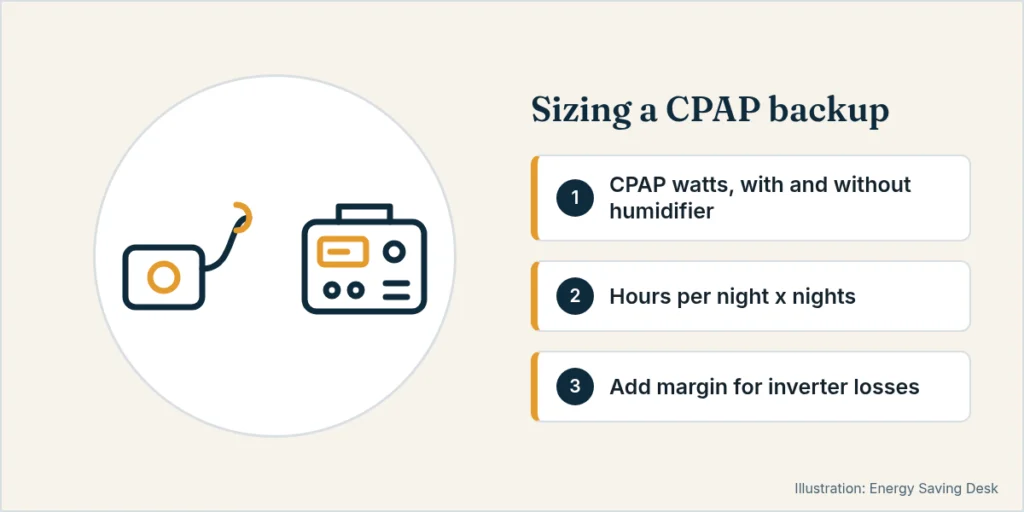
- Take your nightly Wh from the table or your meter.
- Add the power station’s own losses. Converting battery power to AC and back to DC in the CPAP’s power brick loses roughly 10–20%, and the station’s inverter draws power just by being on. BLUETTI, for example, puts the AC180’s self-consumption at about 15 W, which is about 120 Wh over 8 hours.
- Multiply by the number of nights you want to cover without recharging.
That gives you a rough guide:
- One night with humidifier on: a 1 kWh unit gives comfortable headroom. A 500 Wh unit is marginal.
- Two or three nights with humidifier off: a 500 Wh–1 kWh unit is usually enough.
- Several nights with humidifier on: 2 kWh or more, or a way to recharge (solar panels, car charging).
Use DC if you can
Running a CPAP from a power station’s AC socket means converting twice: battery DC to household AC, then back to DC in the CPAP’s power supply. ResMed sells an Air11 DC/DC converter that runs the AirSense 11 from a 12 V or 24 V vehicle-style outlet. Check the converter’s manual for whether it supports the humidifier and heated tube on your setup. Most power stations have a 12 V car socket. Running the CPAP that way avoids the inverter’s standby draw and conversion losses. Other CPAP brands sell similar converters, so check your model.
Features that matter for CPAP users
- UPS or pass-through mode with fast switchover. If the station sits between the wall and your CPAP, it can take over when the power fails. Many current models switch in about 10–20 ms. Test it once on purpose, during the day, so you know what happens.
- Quiet operation. Fans that spin up at night are annoying. Check the stated noise level and whether a quiet charging mode exists.
- A 12 V output for the DC converter.
- LFP battery chemistry for long life and stability.
Models that fit common needs
| Need | Example models (spec-based) |
|---|---|
| One or two nights, light to carry | BLUETTI AC180 (1,152 Wh); Anker SOLIX C1000 Gen 2 (1,024 Wh) |
| Expandable later | EcoFlow DELTA 3 Plus (1,024 Wh, expandable to about 5 kWh) |
| Several nights with humidifier | Jackery Explorer 2000 v2 (2,042 Wh original; 2,048 Wh on the 2027 UK listing) |
See our EcoFlow vs Anker comparison and Jackery vs BLUETTI for details. UK buyers looking at the 2 kWh class: check current price at Jackery UK for the Explorer 2000 v2.
Worked example: why DC can double your nights
Take a CPAP with the humidifier and heated tube off, drawing about 100 Wh a night at the machine. That’s the middle of the range in the table above. The power station is a 1 kWh-class unit with about 80% usable, or roughly 820 Wh, which is the same rule of thumb as in our fridge runtime guide.
- From the AC socket: 100 Wh ÷ 0.85 for conversion losses ≈ 118 Wh. Add the inverter’s idle draw, about 15 W × 8 hours = 120 Wh (BLUETTI’s AC180 figure), for about 238 Wh a night. That’s about 3.4 nights.
- From the 12 V socket with a DC converter: roughly 100 Wh plus an assumed 10% converter loss ≈ 110 Wh a night. That’s about 7 nights.
- Humidifier on, from AC: about 450 Wh ÷ 0.85 + 120 Wh ≈ 650 Wh a night. That’s one night with some margin, which matches the sizing advice above.
Idle draw varies by model, so use your own station’s figure. The pattern holds, though: for a small load running all night, the inverter’s own consumption can cost as much energy as the CPAP itself.
Who this guide isn’t enough for
- Anyone on life-sustaining equipment, such as a ventilator or oxygen concentrator. Make a backup plan with your clinician and equipment supplier. In Great Britain, also join your energy supplier’s and network operator’s Priority Services Register. Ofgem says this gives priority support in an emergency and, wherever possible, advance notice of planned power cuts. It doesn’t guarantee your power stays on.
- Areas with multi-day outages where you want the humidifier every night. No portable unit covers that alone. You need a recharge plan (solar, car, generator) or a much bigger battery.
Honest drawbacks: a 1 kWh unit weighs well over 10 kg, which is a lot to keep beside the bed. Fans can run while charging. And a power station left unused slowly loses charge, so top it up every few months or it may be half-empty on the night you need it.
FAQ
Can I run my CPAP without the humidifier during an outage?
Many people do for a night or two, and it cuts power use sharply. Whether it’s right for you is a question for your doctor or equipment supplier.
Will a power station damage my CPAP?
Use one with a pure sine wave inverter. Official specs for the Jackery Explorer 2000 v2, the BLUETTI AC180 and the EcoFlow DELTA 3 Plus all list one; check the official listing for the Anker model. Or use the manufacturer’s DC converter.
Can I use the power station while it charges?
Most current models support pass-through charging. Check the manual for your model and whether it supports UPS-style switchover.
More guides in Power Stations & Portable Power.
Sources
- ResMed AirSense 11 user guide (power supply, typical and peak consumption): https://www.apria.com/hubfs/User%20Manual/Airsense11-product-manual.pdf
- ResMed Air11 DC/DC converter: https://shop.resmed.com/GB/en/cpap-spare-parts/airsense-11-converter/p/39231
- BLUETTI AC180 product page (runtime formula, self-consumption; inverter type: pure sine wave, checked 13 Nov 2026): https://www.bluettipower.com/products/ac180
- EcoFlow DELTA 3 Plus FAQ (pure sine wave AC output, checked 13 Nov 2026): https://www.ecoflow.com/ca/blog/ecoflow-delta-3-plus-faq
- Ofgem, join your supplier’s Priority Services Register: https://www.ofgem.gov.uk/your-energy-supply/how-manage-your-energy-supply/join-your-suppliers-priority-services-register
- Jackery Explorer 2000 v2 UK product page (checked 11 Nov 2026; the current in-stock listing is the 2027 edition at 2,048 Wh; the earlier Explorer 2000 v2 variant was marked sold out that day): Jackery Explorer 2000 v2 product page (UK)
- Jackery Explorer 2000 v2 basic information (original model figures: 2,042 Wh, 18 W standby, 4,400 W surge, about 17.9 kg, 4,000 cycles to 70%, 20 ms UPS, AC recharge around 2 hours; pure sine wave output; FAQ updated 24 Sep 2026, read 11 Nov 2026, inverter type re-read 13 Nov 2026): https://faq.jackery.com/hc/en-us/articles/52303644507803-Explorer-2000-V2-Basic-Information