Loft and Attic Insulation: Cost, Savings and How Much You Need
Last checked: October 29, 2026. Reviewed and expanded on October 31, 2026. UK figures are the Energy Saving Trust’s (July 2026 prices, gas-heated home, Great Britain).
Updated 13 Nov 2026: tables re-checked against the Energy Saving Trust’s current loft insulation figures; mid-terrace and bungalow top-up rows added.
Insulating an empty loft is one of the few home improvements that pays for itself in a few years. Topping up a loft that already has some insulation is a much weaker deal. Most of the benefit comes from the first layer, so check what’s up there before you spend money.
UK: what it costs and saves
Loft with no insulation, insulated to 270 mm:
| Home type | Typical cost | Saving per year |
|---|---|---|
| Detached house | £1,100 | £360 |
| Semi-detached | £750 | £190 |
| Mid-terrace | £650 | £140 |
| Detached bungalow | £1,200 | £350 |
Topping up from 120 mm to 270 mm:
| Home type | Typical cost | Saving per year |
|---|---|---|
| Detached | £800 | £35 |
| Semi-detached | £600 | £17 |
| Mid-terrace | £500 | £13 |
| Detached bungalow | £800 | £35 |
The first table pays back in about two to five years. The second can take decades. If your loft already has 100 mm or more, put your money into draught-proofing or cavity wall insulation first.
And the walls?
If your house has unfilled cavity walls, the EST puts cavity wall insulation at about £2,200 for a semi, saving about £200 a year (£3,900 / £380 for a detached house, £1,100 / £110 for a mid-terrace). It isn’t suitable everywhere. The EST flags cavities narrower than 50 mm, walls exposed to driving rain or flooding, and walls in poor condition. Solid wall insulation is a much bigger job, around £12,000–£15,000.
Worked payback from the EST figures
Simple payback is cost ÷ yearly saving. The EST figures are typical installed costs:
- Empty loft to 270 mm: detached house about 3.1 years (£1,100 ÷ £360), semi about 3.9, mid-terrace about 4.6, detached bungalow about 3.4.
- Topping up from 120 mm to 270 mm: detached about 23 years (£800 ÷ £35), semi about 35 years (£600 ÷ £17), mid-terrace about 38 years (£500 ÷ £13), detached bungalow about 23 years.
- Cavity walls: semi about 11 years (£2,200 ÷ £200), detached about 10, mid-terrace about 10.
The pattern is clear. The first layer of insulation earns its keep quickly, and every extra layer earns less. DIY on an easy loft cuts the cost and shortens the payback further. Topping up an already insulated loft is mostly a comfort upgrade, not a money one.
To run the same cost ÷ saving sum with your own quote, use our is it worth switching? calculator.
Who should skip or wait
- Lofts that already have 100 mm or more. Do draughts, controls and cavity walls first.
- Lofts you use for storage. To avoid squashing 270 mm of insulation you need raised boarding, which adds cost. Price that in.
- Any sign of damp or condensation in the roof space. Find the cause first, because more insulation makes a cold loft colder.
- A roof replacement planned within a few years. Ask whether insulating at rafter level as part of that job makes more sense.
What if you heat with a heat pump or electricity?
The EST savings assume a gas-heated home. At this winter’s capped prices, a kWh of heat from a 90% gas boiler costs about 8.9p (7.97p ÷ 0.9). From a heat pump at SCOP 3, it’s about 8.8p (26.32p ÷ 3). That’s almost the same, so the savings above carry over to a typical heat pump home. With direct electric heating (panel or storage heaters on a standard rate), a kWh of heat costs the full 26.32p. That’s about three times as much, so insulation saves roughly three times as much and pays back about three times faster. Off-peak storage heater tariffs narrow that gap.
US: how much attic insulation you need
In the US, insulation is measured in R-value. ENERGY STAR recommends attic levels from about R30 in the warmest zones to R49–R60 in most of the country. If you can see the tops of your floor joists, you almost certainly need more. Air-seal the attic floor first (around light fittings, pipes and the attic hatch), because insulation doesn’t stop air leaks. The DOE’s air sealing guide covers this step by step.
DIY or professional?
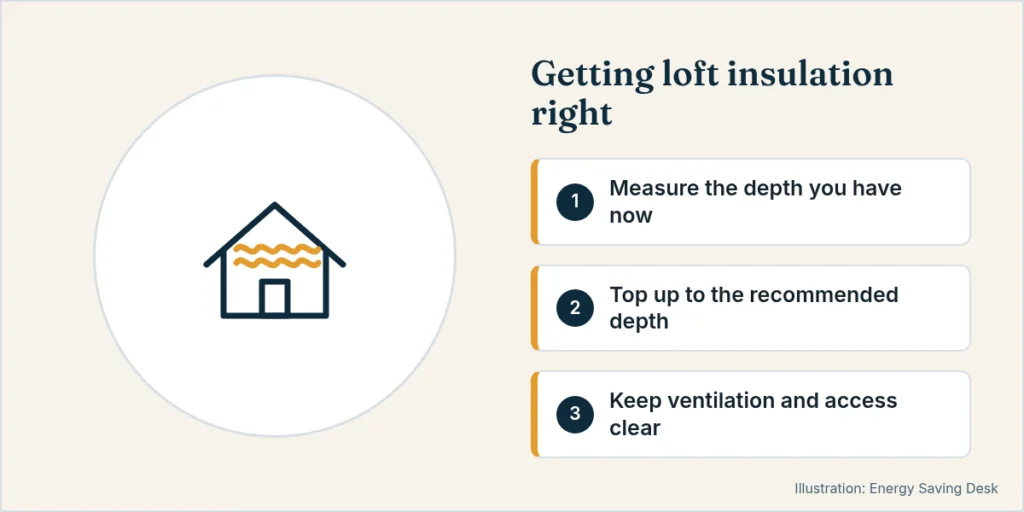
DIY is realistic for an accessible, dry loft with joists you can see. Rolls of mineral wool go between the joists, with a second layer at right angles across them. Wear a mask, gloves and long sleeves, and board walkways rather than squashing insulation, because compressed insulation loses much of its value.
Use a professional for loose-fill or blown insulation, awkward or low-pitch roofs, any sign of damp, or rooms in the roof.
Don’t create new problems
- Keep the eaves ventilated. Blocking airflow at the edges can cause condensation on the roof timbers.
- Insulate the loft hatch and fit a draught seal around it.
- Lag pipes and tanks in the loft. Once insulated, the loft gets colder and they can freeze.
- Leave space around recessed lights unless they’re rated for contact with insulation.
FAQ
Is there a grant for loft insulation in the UK?
The support has changed. The Great British Insulation Scheme closed to new installations on March 31, 2026, and ECO4 is only finishing existing work until the end of 2026. In England, help for low-income households now runs mainly through the Warm Homes: Local Grant, run by local councils until March 2028. Ask your council whether you qualify. Scotland, Wales and Northern Ireland run their own schemes.
How thick should UK loft insulation be?
The EST recommends 270 mm of mineral wool.
Will it make my house cooler in summer?
Yes, it also slows heat coming in through the roof.
Related
More guides in Insulation & Draught-Proofing.
Sources
- Energy Saving Trust, roof and loft insulation (savings tables by home type, checked November 13, 2026): https://energysavingtrust.org.uk/advice/roof-and-loft-insulation/
- Energy Saving Trust, cavity wall insulation: https://energysavingtrust.org.uk/advice/cavity-wall-insulation/
- Energy Saving Trust, retrofit explained (solid wall costs): https://energysavingtrust.org.uk/retrofit-explained/
- ENERGY STAR, recommended home insulation R-values: https://www.energystar.gov/saveathome/seal_insulate/identify-problems-you-want-fix/diy-checks-inspections/insulation-r-values
- U.S. DOE, guide to air sealing: https://www.energy.gov/sites/prod/files/guide_to_air_sealing.pdf
- GOV.UK, Great British Insulation Scheme (closed March 31, 2026): https://www.gov.uk/apply-great-british-insulation-scheme
- GOV.UK, ECO4 end date extension (government response): https://www.gov.uk/government/consultations/extending-the-eco4-end-date/outcome/extending-the-eco4-end-date-government-response-html
- GOV.UK, Warm Homes Plan: https://www.gov.uk/government/publications/warm-homes-plan/warm-homes-plan-html